Page 1 of 1
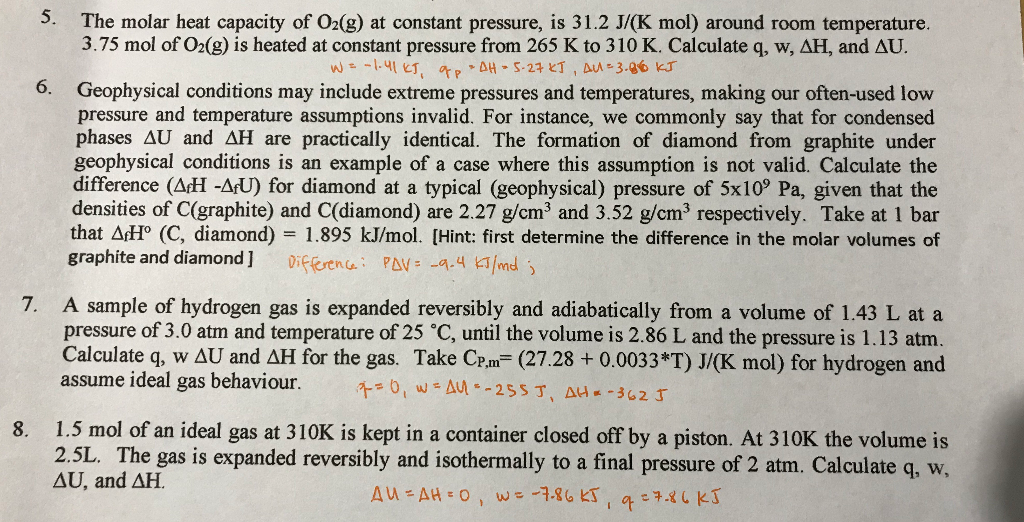
5. The molar heat capacity of O2(g) at constant pressure, is 31.2 J/(K mol) around room temperature. 3.75 mol of O2(g) i
Posted: Mon Jul 18, 2022 5:55 am
by answerhappygod
- 5 The Molar Heat Capacity Of O2 G At Constant Pressure Is 31 2 J K Mol Around Room Temperature 3 75 Mol Of O2 G I 1 (840.02 KiB) Viewed 43 times
5. The molar heat capacity of O2(g) at constant pressure, is 31.2 J/(K mol) around room temperature. 3.75 mol of O2(g) is heated at constant pressure from 265 K to 310 K. Calculate q, w, AH, and AU. W = -1.41 KJ qoAH 5.27 KJ, AU - 3.86 kJ Geophysical conditions may include extreme pressures and temperatures, making our often-used low pressure and temperature assumptions invalid. For instance, we commonly say that for condensed phases AU and AH are practically identical. The formation of diamond from graphite under geophysical conditions is an example of a case where this assumption is not valid. Calculate the difference (AH-AU) for diamond at a typical (geophysical) pressure of 5x10⁹ Pa, given that the densities of C(graphite) and C(diamond) are 2.27 g/cm3 and 3.52 g/cm respectively. Take at 1 bar that AfHº (C, diamond) = 1.895 kJ/mol. (Hint: first determine the difference in the molar volumes of graphite and diamond] Difference: PAV: -9.4 kmd; 7. A sample of hydrogen gas is expanded reversibly and adiabatically from a volume of 1.43 L at a pressure of 3.0 atm and temperature of 25 °C, until the volume is 2.86 L and the pressure is 1.13 atm. Calculate q, w AU and AH for the gas. Take Cp,m=(27.28 + 0.0033*T) J/(K mol) for hydrogen and assume ideal gas behaviour. q=0, w = All *-255J, AH-3625 1.5 mol of an ideal gas at 310K is kept in a container closed off by a piston. At 310K the volume is 2.5L. The gas is expanded reversibly and isothermally to a final pressure of 2 atm. Calculate q, w, AU, and AH. AU=AH=0, w = -7.86 kJ, q = 7.86 kJ 8.