- Written Homework Gauss Law And Conductors 1 A Thin Square Conducting Slab With Dimensions Lxl Has Total Change Q It 1 (639.16 KiB) Viewed 46 times
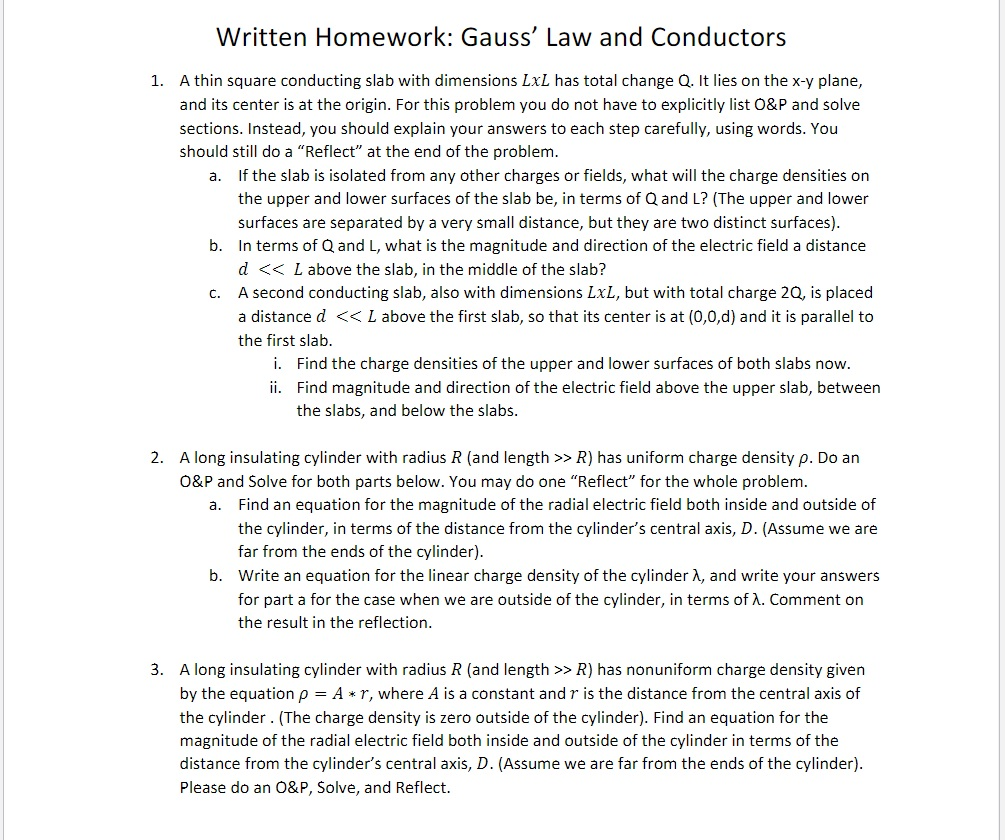
Written Homework: Gauss' Law and Conductors 1. A thin square conducting slab with dimensions LxL has total change Q. It lies on the x-y plane, and its center is at the origin. For this problem you do not have to explicitly list O&P and solve sections. Instead, you should explain your answers to each step carefully, using words. You should still do a "Reflect" at the end of the problem. a. If the slab is isolated from any other charges or fields, what will the charge densities on the upper and lower surfaces of the slab be, in terms of Q and L? (The upper and lower surfaces are separated by a very small distance, but they are two distinct surfaces). b. In terms of Q and L, what is the magnitude and direction of the electric field a distance d << L above the slab, in the middle of the slab? C. A second conducting slab, also with dimensions LxL, but with total charge 20, is placed a distance d << L above the first slab, so that its center is at (0,0,d) and it is parallel to the first slab. i. Find the charge densities of the upper and lower surfaces of both slabs now. ii. Find magnitude and direction of the electric field above the upper slab, between the slabs, and below the slabs. 2. A long insulating cylinder with radius R (and length >> R) has uniform charge density p. Do an O&P and Solve for both parts below. You may do one "Reflect" for the whole problem. a. Find an equation for the magnitude of the radial electric field both inside and outside of the cylinder, in terms of the distance from the cylinder's central axis, D. (Assume we are far from the ends of the cylinder). b. Write an equation for the linear charge density of the cylinder, and write your answers for part a for the case when we are outside of the cylinder, in terms of . Comment on the result in the reflection. 3. A long insulating cylinder with radius R (and length >> R) has nonuniform charge density given by the equation p = A*r, where A is a constant and r is the distance from the central axis of the cylinder. (The charge density is zero outside of the cylinder). Find an equation for the magnitude of the radial electric field both inside and outside of the cylinder in terms of the distance from the cylinder's central axis, D. (Assume we are far from the ends of the cylinder). Please do an O&P, Solve, and Reflect.