Page 1 of 1
Here we will consider the problem of Cooper pair with spin-dependent effective masses. This can occur in certain materia
Posted: Tue Apr 26, 2022 7:12 pm
by answerhappygod
- Here We Will Consider The Problem Of Cooper Pair With Spin Dependent Effective Masses This Can Occur In Certain Materia 1 (80.34 KiB) Viewed 40 times
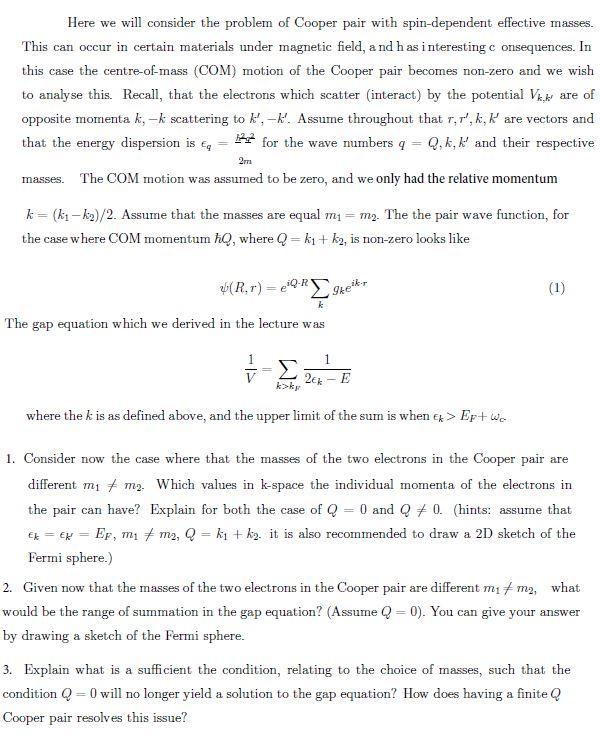
Here we will consider the problem of Cooper pair with spin-dependent effective masses. This can occur in certain materials under magnetic field, a nd has interesting consequences. In this case the centre-of-mass (COM) motion of the Cooper pair becomes non-zero and we wish to analyse this. Recall, that the electrons which scatter interact) by the potential Vk are of opposite momenta k,-k scattering to k', -k'. Assume throughout that r,r',k,k' are vectors and that the energy dispersion is ca for the wave numbers q-Q,, k' and their respective 2m masses. The COM motion was assumed to be zero, and we only had the relative momentum k={kt – ka)/2. Assume that the masses are equal mı = m2. The the pair wave function, for the case where COM momentum HQ, where Q=ki + ka, is non-zero looks like (1) (R,r) – 20. Steikt The gap equation which we derived in the lecture was k 1 1 - 24 - E V Σ k>k where the k is as defined above, and the upper limit of the sum is when ex> Ep+ wc 1. Consider now the case where that the masses of the two electrons in the Cooper pair are different mı + m2. Which values in k-space the individual momenta of the electrons in the pair can have? Explain for both the case of Q = 0 and Q +0. (hints: assume that Ep, mi + m2, Q = ki + k2. it is also recommended to draw a 2D sketch of the Fermi sphere.) 2. Given now that the masses of the two electrons in the Cooper pair are different mitme, what would be the range of summation in the gap equation? (Assume Q=0). You can give your answer by drawing a sketch of the Fermi sphere. 3. Explain what is a sufficient the condition, relating to the choice of masses, such that the condition Q=0 will no longer yield a solution to the gap equation? How does having a finite Q Cooper pair resolves this issue?