Page 1 of 1
Here we will consider the problem of Cooper pair with spin-dependent effective masses. This can occur in certain materia
Posted: Tue Apr 26, 2022 7:12 pm
by answerhappygod
- Here We Will Consider The Problem Of Cooper Pair With Spin Dependent Effective Masses This Can Occur In Certain Materia 1 (58.72 KiB) Viewed 42 times
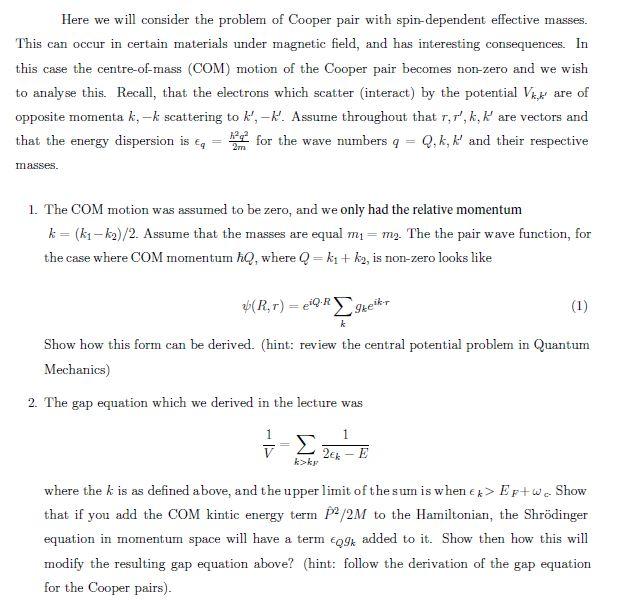
Here we will consider the problem of Cooper pair with spin-dependent effective masses. This can occur in certain materials under magnetic field, and has interesting consequences. In this case the centre-of-mass (COM) motion of the Cooper pair becomes non-zero and we wish to analyse this. Recall, that the electrons which scatter interact) by the potential V1H are of opposite momenta k,-k scattering to k', -k'. Assume throughout that 7,7',k, K are vectors and that the energy dispersion is eq Hd for the wave numbers Q,k,k! and their respective 2m masses. 1. The COM motion was assumed to be zero, and we only had the relative momentum k= (kı - ka)/2. Assume that the masses are equal mu=m2. The the pair wave function, for the case where COM momentum hq, where Q=ki+ ka, is non-zero looks like *(R,r) = ciq.rgteikt (1) k Show how this form can be derived. (hint: review the central potential problem in Quantum Mechanics) 2. The gap equation which we derived in the lecture was V 26k-E kky c- where the k is as defined above, and the upper limit of the sun is when ek > Ertwe Show that if you add the COM kintic energy term P2/2M to the Hamiltonian, the Shrödinger equation in momentum space will have a term cogk added to it. Show then how this will modify the resulting gap equation above? (hint: follow the derivation of the gap equation for the Cooper pairs).