Page 1 of 1
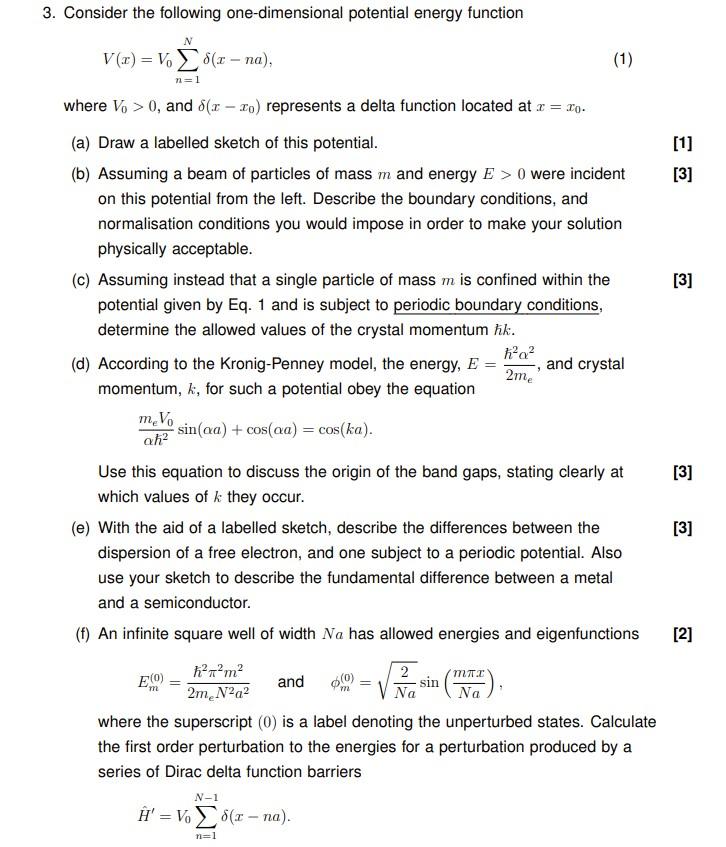
3. Consider the following one-dimensional potential energy function V(r) = 1, (- na), (1) n=1 [1] [3] [3] 2me where V, >
Posted: Tue Apr 26, 2022 7:06 pm
by answerhappygod
- 3 Consider The Following One Dimensional Potential Energy Function V R 1 Na 1 N 1 1 3 3 2me Where V 1 (96.83 KiB) Viewed 35 times
3. Consider the following one-dimensional potential energy function V(r) = 1, (- na), (1) n=1 [1] [3] [3] 2me where V, > 0, and 8(x - 2o) represents a delta function located at x = Do. (a) Draw a labelled sketch of this potential. (b) Assuming a beam of particles of mass m and energy E > O were incident on this potential from the left. Describe the boundary conditions, and normalisation conditions you would impose in order to make your solution physically acceptable. (c) Assuming instead that a single particle of mass m is confined within the potential given by Eq. 1 and is subject to periodic boundary conditions, determine the allowed values of the crystal momentum ħk. ha? (d) According to the Kronig-Penney model, the energy, E = and crystal momentum, k, for such a potential obey the equation meV sin(aa) + cos(aa) = cos(ka). ah? Use this equation to discuss the origin of the band gaps, stating clearly at which values of k they occur. (e) With the aid of a labelled sketch, describe the differences between the dispersion of a free electron, and one subject to a periodic potential. Also use your sketch to describe the fundamental difference between a metal and a semiconductor. (f) An infinite square well of width Na has allowed energies and eigenfunctions t?r?m? 2 E(0) and sin 2m N2q2 ( Na Na where the superscript (0) is a label denoting the unperturbed states. Calculate the first order perturbation to the energies for a perturbation produced by a series of Dirac delta function barriers [3] [3] [2] тТт N-1 H' = V. (x - na). n=1