Page 1 of 1
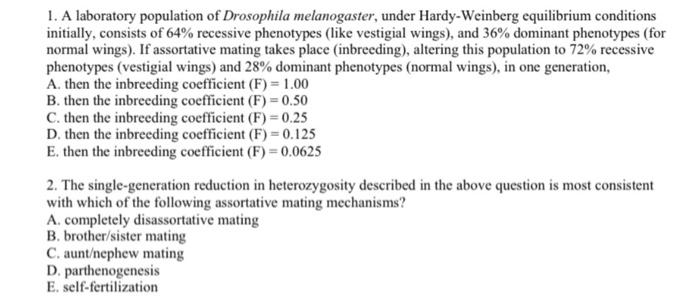
1. A laboratory population of Drosophila melanogaster, under Hardy-Weinberg equilibrium conditions initially, consists o
Posted: Fri Jul 15, 2022 5:19 pm
by answerhappygod
- 1 A Laboratory Population Of Drosophila Melanogaster Under Hardy Weinberg Equilibrium Conditions Initially Consists O 1 (33.46 KiB) Viewed 42 times
1. A laboratory population of Drosophila melanogaster, under Hardy-Weinberg equilibrium conditions initially, consists of 64% recessive phenotypes (like vestigial wings), and 36% dominant phenotypes (for normal wings). If assortative mating takes place (inbreeding), altering this population to 72% recessive phenotypes (vestigial wings) and 28% dominant phenotypes (normal wings), in one generation, A. then the inbreeding coefficient (F)=1.00 B. then the inbreeding coefficient (F)=0.50 C. then the inbreeding coefficient (F)=0.25 D. then the inbreeding coefficient (F)=0.125 E. then the inbreeding coefficient (F)=0.0625 2. The single-generation reduction in heterozygosity described in the above question is most consistent with which of the following assortative mating mechanisms? A. completely disassortative mating B. brother/sister mating C. aunt/nephew mating D. parthenogenesis E. self-fertilization