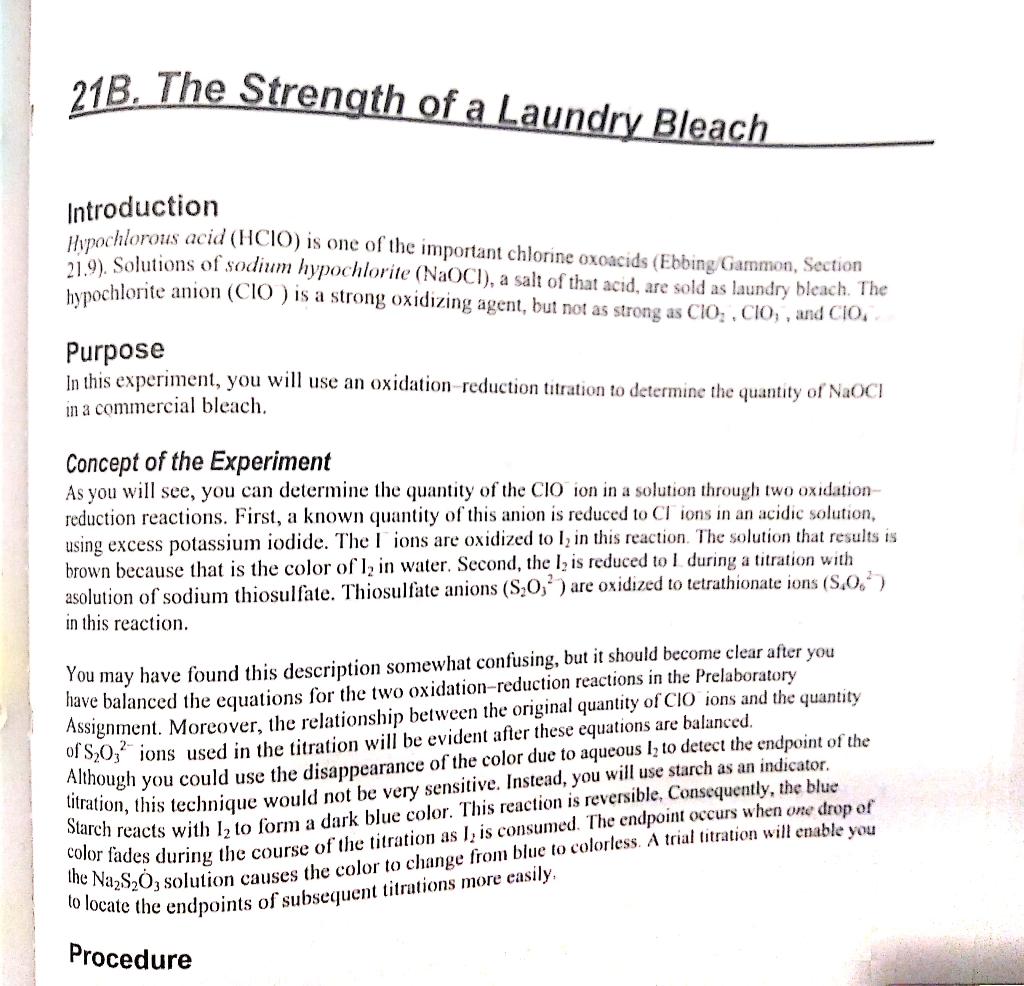
- Introducilon Hypochlorous Acid Hclo Is One Of The Important Chlorine Oxoacids Ebbing Gammon Section 21 9 Solutions 1 (154.8 KiB) Viewed 57 times
Introducilon Hypochlorous acid (HClO) is one of the important chlorine oxoacids (Ebbing Gammon, Section 21.9). Solutions of sodium hypochlorite ( NaOCl), a salt of that acid, are sold as laundry bleach. The hypochlorite anion (ClO) is a strong oxidizing agent, but not as strong as ClO2,ClO3, and ClO4 Purpose In this experiment, you will use an oxidation-reduction titration to determine the quantity of NaOCl in a commercial bleach. Concept of the Experiment As you will see, you can determine the quantity of the ClO−ion in a solution through two oxidationreduction reactions. First, a known quantity of this anion is reduced to Cl ions in an acidic solution, using excess potassium iodide. The I ions are oxidized to I2 in this reaction. The solution that results is brown because that is the color of I2 in water. Second, the I2 is reduced to 1 during a titration with asolution of sodium thiosulfate. Thiosulfate anions (S2O32) are oxidized to tetrathionate ions (S4O62) in this reaction. You may have found this description somewhat confusing, but it should become clear after you have balanced the equations for the two oxidation-reduction reactions in the Prelaboratory Assignment. Moreover, the relationship between the original quantity of ClO ions and the quantity of S2O32− ions used in the titration will be evident after these equations are balanced. Although you could use the disappearance of the color due to aqueous I2 to detect the endpoint of the titration, this technique would not be very sensitive. Instead, you will use starch as an indicator. Starch reacts with I2 to form a dark blue color. This reaction is reversible, Consequently, the blue color fades during the course of the titration as I2 is consumed. The endpoint occurs when one drop of the Na2 S2O˙3 solution causes the color to change from blue to colorless. A trial titration will enable you to locate the endpoints of subsequent titrations more easily.
Experiment 218 412 3. Exact tirrations Trial 23 4 Volume of diluted bleach used (mL) Final buret reading (mL) 10 1010 10 Initial buret reading (mL) 6.6 7.165 7 Volume of 0.0250MNa2 S2O3( mL) 0.10.2 0.1 0.2 Molēs of Na2 S2O3 656,9 Moles of NaOCl .1625.1725.1512.17 0325325+345+3025×31 Molarity of NaOCl in diluted bleach (M)+43 03025 +634 Mean molarity (M) 0,03 Calculations:
a. Calculate the molarity of the undiluted bleach solution. b. Commercial bleaches such as Clorox are said to contain 5.25%NaOCl by weight. Is this correct? Use your results and a density of 1.0 g/mL for the bleach in your calculations. These calculations should reflect the precision of the assumed density.