Page 1 of 1
Journalists and politicians often suggest the high levels of salt runoff into the Flint River from winter deicing tactic
Posted: Fri Jul 15, 2022 4:46 pm
by answerhappygod
- Journalists And Politicians Often Suggest The High Levels Of Salt Runoff Into The Flint River From Winter Deicing Tactic 1 (49.68 KiB) Viewed 39 times
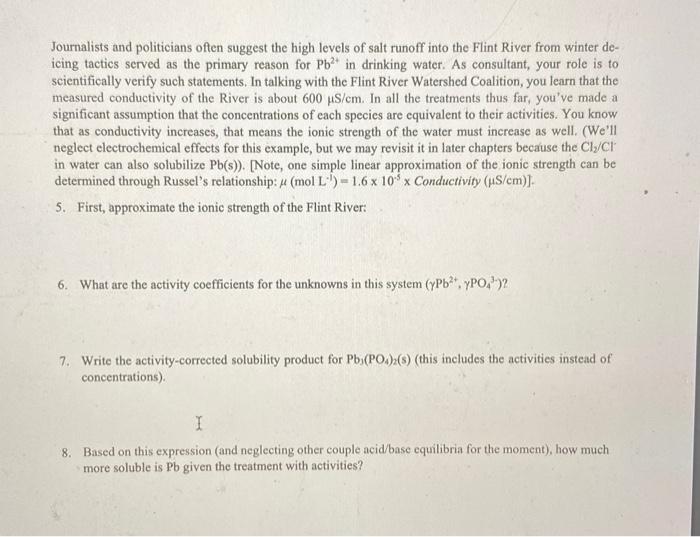
Journalists and politicians often suggest the high levels of salt runoff into the Flint River from winter deicing tactics served as the primary reason for Pb2+ in drinking water. As consultant, your role is to scientifically verify such statements. In talking with the Flint River Watershed Coalition, you learn that the measured conductivity of the River is about 600μS/cm. In all the treatments thus far, you've made a significant assumption that the concentrations of each species are equivalent to their activities. You know that as conductivity increases, that means the ionic strength of the water must increase as well. (We'll neglect electrochemical effects for this example, but we may revisit it in later chapters because the Cl2/Cl in water can also solubilize Pb(s) ). [Note, one simple linear approximation of the ionic strength can be determined through Russel's relationship: μ(molL−1)=1.6×10⁻⁵× Conductivity (μS/cm)]. 5. First, approximate the ionic strength of the Flint River: 6. What are the activity coefficients for the unknowns in this system (γPb2+,γPO43) ? 7. Write the activity-corrected solubility product for Pb3(PO4)2( s) (this includes the activities instead of concentrations). 8. Based on this expression (and neglecting other couple acid/base equilibria for the moment), how much more soluble is Pb given the treatment with activities?