Page 1 of 1
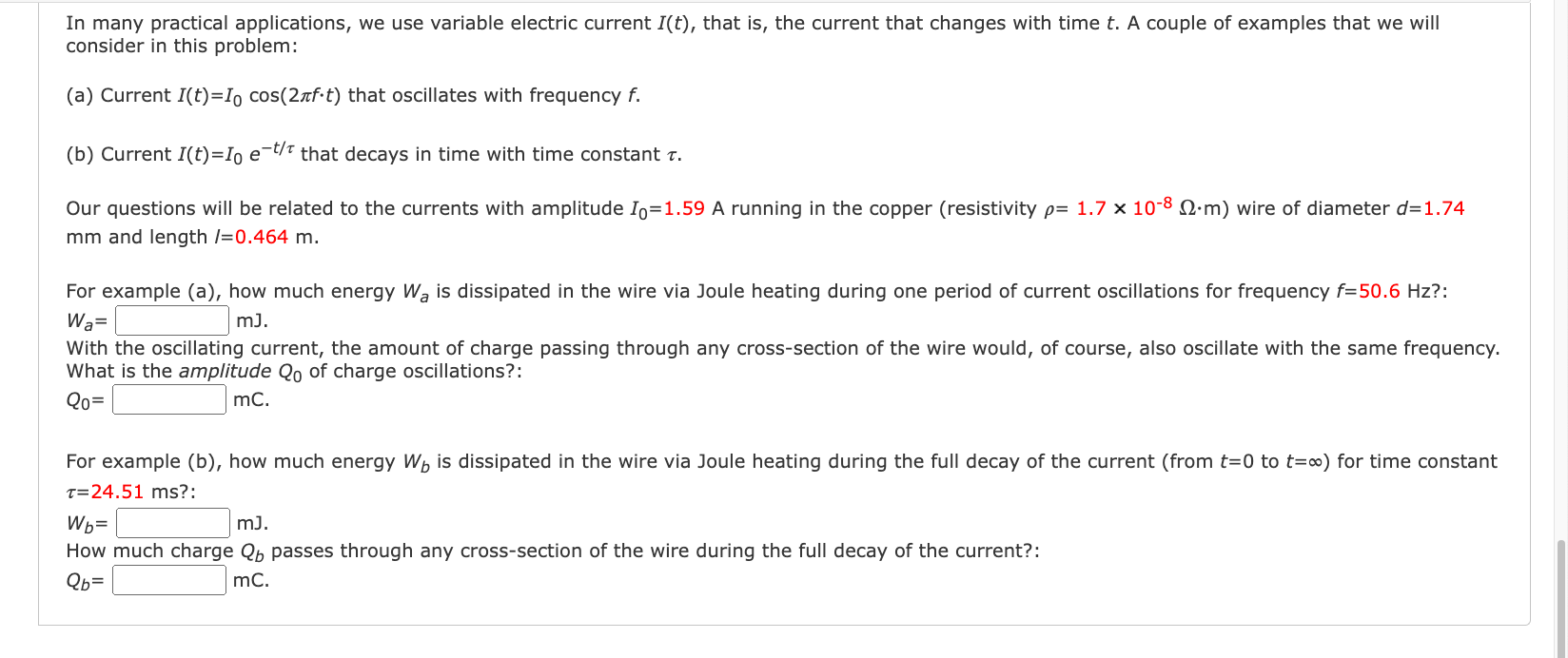
In many practical applications, we use variable electric current I(t), that is, the current that changes with time t. A
Posted: Fri Jul 15, 2022 7:26 am
by answerhappygod
- In Many Practical Applications We Use Variable Electric Current I T That Is The Current That Changes With Time T A 1 (104.14 KiB) Viewed 42 times
In many practical applications, we use variable electric current I(t), that is, the current that changes with time t. A couple of examples that we will consider in this problem: (a) Current I(t)=I0cos(2πf⋅t) that oscillates with frequency f. (b) Current I(t)=I0e−t/τ that decays in time with time constant τ. Our questions will be related to the currents with amplitude I0=1.59 A running in the copper (resistivity ρ=1.7×10⁻⁸Ω⋅m ) wire of diameter d=1.74 mm and length l=0.464 m. For example (a), how much energy Wa is dissipated in the wire via Joule heating during one period of current oscillations for frequency f=50.6 Hz? Wa=□mJ. With the oscillating current, the amount of charge passing through any cross-section of the wire would, of course, also oscillate with the same frequency What is the amplitude Q0 of charge oscillations?: Q0=mC. For example (b), how much energy Wb is dissipated in the wire via Joule heating during the full decay of the current (from t=0 to t=∞ ) for time constan τ=24.51 ms ?: Wb=mJ. How much charge Qb passes through any cross-section of the wire during the full decay of the current?: Qb=mC.