Page 1 of 1
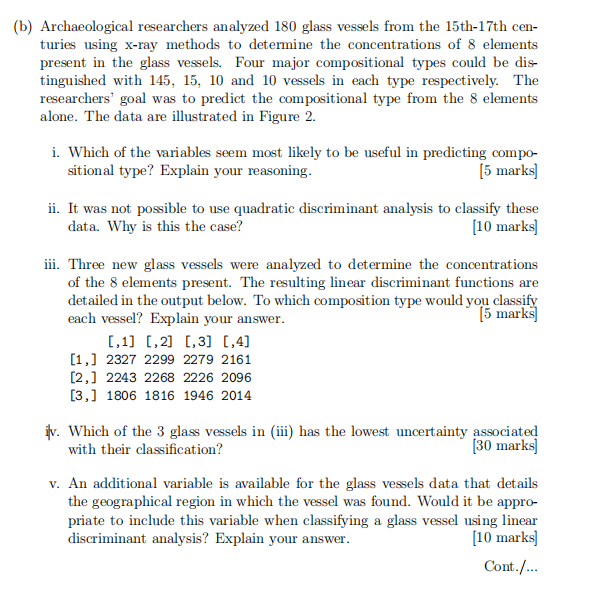
Archaeological researchers analyzed 180 glass vessels from the 15 th- 17 th centuries using x-ray methods to determine t
Posted: Thu Jul 14, 2022 4:53 pm
by answerhappygod
- Archaeological Researchers Analyzed 180 Glass Vessels From The 15 Th 17 Th Centuries Using X Ray Methods To Determine T 1 (90.74 KiB) Viewed 40 times
Archaeological researchers analyzed 180 glass vessels from the 15 th- 17 th centuries using x-ray methods to determine the concentrations of 8 elements present in the glass vessels. Four major compositional types could be distinguished with 145,15,10 and 10 vessels in each type respectively. The researchers' goal was to predict the compositional type from the 8 elements alone. The data are illustrated in Figure 2. i. Which of the variables seem most likely to be useful in predicting compositional type? Explain your reasoning. [5 marks] ii. It was not possible to use quadratic discriminant analysis to classify these data. Why is this the case? [10 marks] iii. Three new glass vessels were analyzed to determine the concentrations of the 8 elements present. The resulting linear discriminant functions are detailed in the output below. To which composition type would you classify each vessel? Explain your answer. [5 marks] [,1][,2][,3][,4] [1,], [2, ] 2243226822262096 [3,] 1806181619462014 iv. Which of the 3 glass vessels in (iii) has the lowest uncertainty associated with their classification? [30 marks] v. An additional variable is available for the glass vessels data that details the geographical region in which the vessel was found. Would it be appropriate to include this variable when classifying a glass vessel using linear discriminant analysis? Explain your answer. [10 marks] Cont./...
Eigure 2: Pairs plot of the 8 elements in the glass vessels data. Vessels from the four lifferent compositional types are illustrated using different colours and shapes. vi. The k-nearest neighbours classification algorithm is an alternative, nonparametric classification technique. How might one report the uncertainty in the resulting classification when using the k-nearest neighbours classification algorithm? [10 marks] vii. The k-nearest neighbours algorithm often performs poorly when p is large. Why is this the case? [10 marks]