- 1 (195.56 KiB) Viewed 44 times
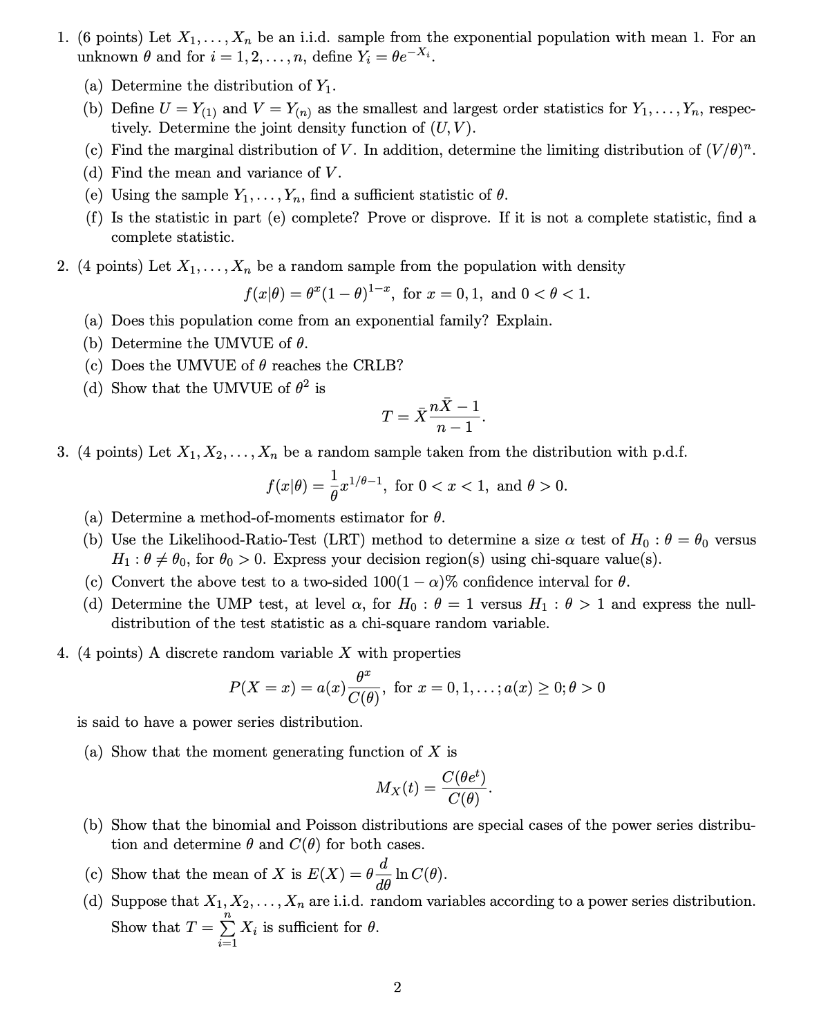
1. (6 points) Let X1,…,Xn be an i.i.d. sample from the exponential population with mean 1 . For an unknown θ and for i=1,2,…,n, define Yi=θe−Xi. (a) Determine the distribution of Y1. (b) Define U=Y(1) and V=Y(n) as the smallest and largest order statistics for Y1,…,Yn, respectively. Determine the joint density function of (U,V). (c) Find the marginal distribution of V. In addition, determine the limiting distribution of (V/θ)n. (d) Find the mean and variance of V. (e) Using the sample Y1,…,Yn, find a sufficient statistic of θ. (f) Is the statistic in part (e) complete? Prove or disprove. If it is not a complete statistic, find a complete statistic. 2. (4 points) Let X1,…,Xn be a random sample from the population with density f(x∣θ)=θx(1−θ)1−x, for x=0,1, and 0<θ<1. (a) Does this population come from an exponential family? Explain. (b) Determine the UMVUE of θ. (c) Does the UMVUE of θ reaches the CRLB? (d) Show that the UMVUE of θ2 is T=Xˉn−1nXˉ−1. 3. (4 points) Let X1,X2,…,Xn be a random sample taken from the distribution with p.d.f. f(x∣θ)=θ1x1/θ−1, for 0<x<1, and θ>0. (a) Determine a method-of-moments estimator for θ. (b) Use the Likelihood-Ratio-Test (LRT) method to determine a size α test of H0:θ=θ0 versus H1:θ=θ0, for θ0>0. Express your decision region(s) using chi-square value(s). (c) Convert the above test to a two-sided 100(1−α)% confidence interval for θ. (d) Determine the UMP test, at level α, for H0:θ=1 versus H1:θ>1 and express the nulldistribution of the test statistic as a chi-square random variable. 4. (4 points) A discrete random variable X with properties P(X=x)=a(x)C(θ)θx, for x=0,1,…;a(x)≥0;θ>0 is said to have a power series distribution. (a) Show that the moment generating function of X is MX(t)=C(θ)C(θet). (b) Show that the binomial and Poisson distributions are special cases of the power series distribution and determine θ and C(θ) for both cases. (c) Show that the mean of X is E(X)=θdθdlnC(θ). (d) Suppose that X1,X2,…,Xn are i.i.d. random variables according to a power series distribution. Show that T=i=1∑nXi is sufficient for θ.