Page 1 of 1
14.39. Geriatric study. A researcher in geriatrics designed a prospective study to investigate the effects of two interv
Posted: Thu Jul 14, 2022 4:52 pm
by answerhappygod
- 14 39 Geriatric Study A Researcher In Geriatrics Designed A Prospective Study To Investigate The Effects Of Two Interv 1 (88.31 KiB) Viewed 37 times
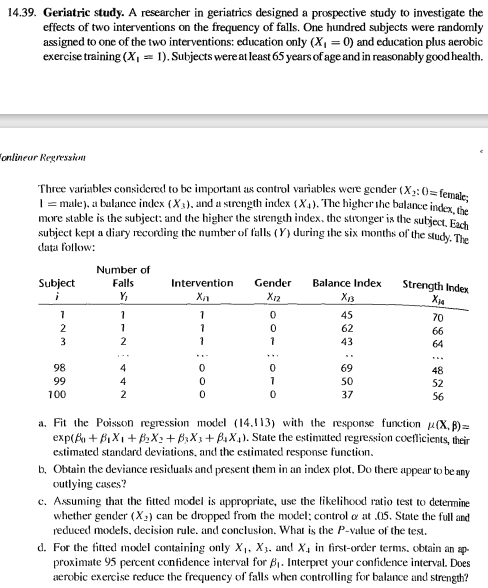
14.39. Geriatric study. A researcher in geriatrics designed a prospective study to investigate the effects of two interventions on the frequency of falls. One hundred subjects were randomly assigned to one of the two interventions: education only (X1=0) and education plus aerobic exercise training (X1=1). Subjects were at least 65 years of age and in reasonably goodhealth. tineur Regeression Three variables considered to be important as control variables were gender (X2:0= female; 1= male), a bulance index (X3), and a strength index (X4). The higher the balance index, the more stable is the subject: and the higher the strength index, the stronger is the subject. Each subject kept a cliary recording the number of falls ( Y ) during the six months of the study. The clata follow: a. Fit the Poisson regression model (14.113) with the response function μ(X,β)= exp(β11+β1X1+β2X2+β3X3+β4X4). State the estimated regression coeflicients, their estimated standard deviations, and the estimated response function. b. Obtain the deviance residuals and present them in an index plot. Do there appear to be any outlying cases? c. Assuming that the fitted model is appropriate, use the likelihood ratio test to determine whether gender ( X2 ) can be dropped from the model; control α at .05. State the full and reduced models, decision rule. and conclusion. Whar is the P-value of the test. d. For the fitted model containing only X1,X3, and X+in first-order terms. obtain an approximate 95 percent confidence interval for β1. Interpret your conficlence interval. Does aerobic exercise reduce the frequency of falls when controlling for balance and strength?