Page 1 of 1
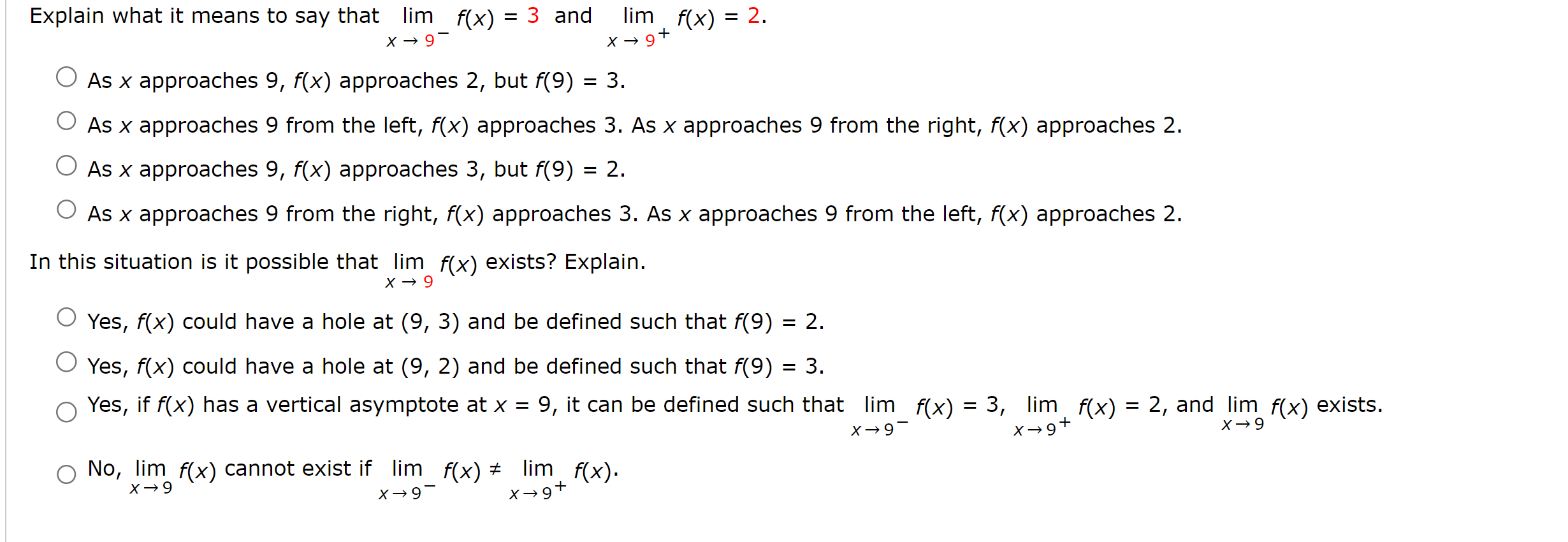
Explain what it means to say that x→9−limf(x)=3 and x→9+limf(x)=2. As x approaches 9,f(x) approaches 2 , but f(9)=3. A
Posted: Thu Jul 14, 2022 4:03 pm
by answerhappygod
- Explain What It Means To Say That X 9 Lim F X 3 And X 9 Lim F X 2 As X Approaches 9 F X Approaches 2 But F 9 3 A 1 (125.29 KiB) Viewed 30 times
Explain what it means to say that x→9−limf(x)=3 and x→9+limf(x)=2. As x approaches 9,f(x) approaches 2 , but f(9)=3. As x approaches 9 from the left, f(x) approaches 3. As x approaches 9 from the right, f(x) approaches 2. As x approaches 9,f(x) approaches 3 , but f(9)=2. As x approaches 9 from the right, f(x) approaches 3. As x approaches 9 from the left, f(x) approaches 2. In this situation is it possible that x→9limf(x) exists? Explain. Yes, f(x) could have a hole at (9,3) and be defined such that f(9)=2. Yes, f(x) could have a hole at (9,2) and be defined such that f(9)=3. Yes, if f(x) has a vertical asymptote at x=9, it can be defined such that x→9−limf(x)=3, x→9+limf(x)=2, and x→9limf(x) exists. No, x→9limf(x) cannot exist if x→9−limf(x)=x→9+limf(x)