Page 1 of 1
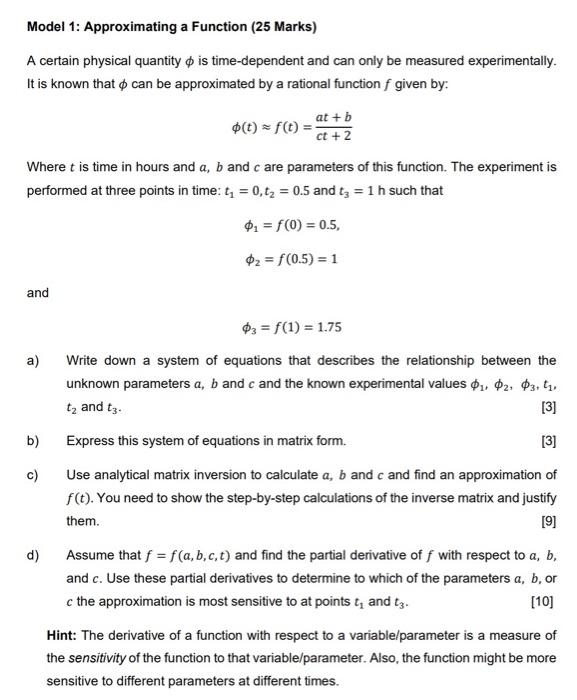
Model 1: Approximating a Function (25 Marks) A certain physical quantity is time-dependent and can only be measured expe
Posted: Tue Apr 26, 2022 5:39 pm
by answerhappygod
- Model 1 Approximating A Function 25 Marks A Certain Physical Quantity Is Time Dependent And Can Only Be Measured Expe 1 (56.75 KiB) Viewed 41 times
Model 1: Approximating a Function (25 Marks) A certain physical quantity is time-dependent and can only be measured experimentally. It is known that can be approximated by a rational function f given by: $(t) = f(t) = ct +2 at + b Where t is time in hours and a, b and care parameters of this function. The experiment is performed at three points in time: t1 = 0,t2 = 0.5 and tz = 1 h such that $1 = f(0) = 0.5, 2 = f(0.5) = 1 and 03 = f(1) = 1.75 a) Write down a system of equations that describes the relationship between the unknown parameters a, b and c and the known experimental values ºu 02, 03, ty tz and tz. [3] Express this system of equations in matrix form. [3] b) c) Use analytical matrix inversion to calculate a, b and c and find an approximation of f(t). You need to show the step-by-step calculations of the inverse matrix and justify them. [9] Assume that f = f(a,b,c,t) and find the partial derivative off with respect to a, b, and c. Use these partial derivatives to determine to which of the parameters a, b, or c the approximation is most sensitive to at points t, and tz. [10] d) Hint: The derivative of a function with respect to a variable/parameter is a measure of the sensitivity of the function to that variable/parameter. Also, the function might be more sensitive to different parameters at different times.