Page 1 of 1
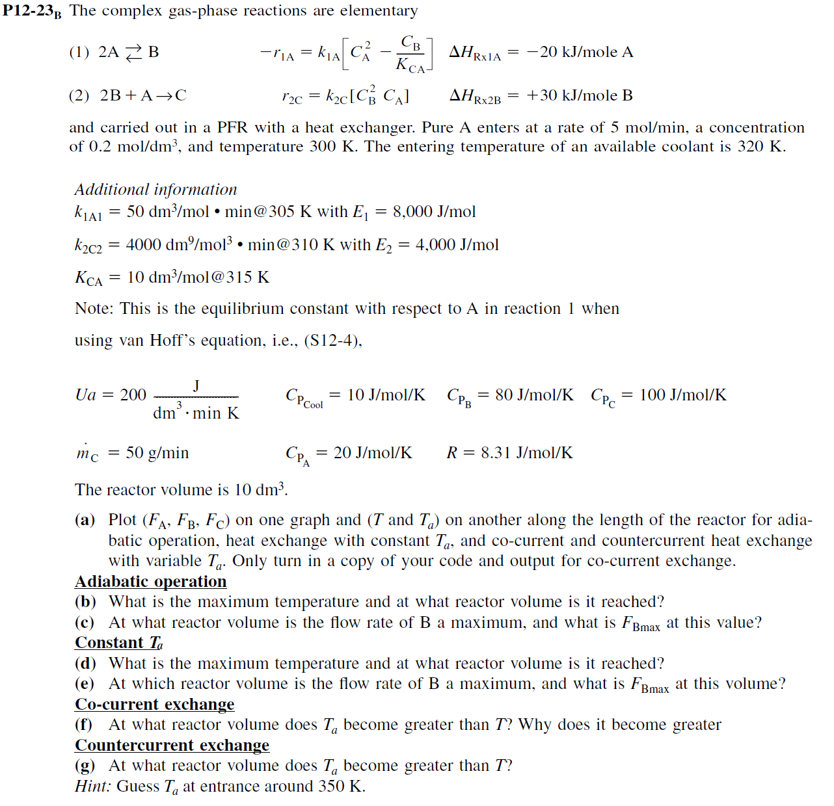
P12−23B The complex gas-phase reactions are elementary (1) 2 A⇄B −r1 A=k1 A[CA2−KCACB]ΔHRxIA=−20 kJ/ mole A (2)
Posted: Thu Jul 14, 2022 3:33 pm
by answerhappygod
- 1 (284.63 KiB) Viewed 38 times
P12−23B The complex gas-phase reactions are elementary (1) 2 A⇄B −r1 A=k1 A[CA2−KCACB]ΔHRxIA=−20 kJ/ mole A (2) 2 B+A→C r2C=k2C[CB2CA]ΔHRx2 B=+30 kJ/ mole B and carried out in a PFR with a heat exchanger. Pure A enters at a rate of 5 mol/min, a concentration of 0.2 mol/dm3, and temperature 300 K. The entering temperature of an available coolant is 320 K. Additional information k1Al=50dm3/mol∙min@305 K with E1=8,000 J/molk2C2=4000dm9/mol3⋅min@310 K with E2=4,000 J/molKCA=10dm3/mol@315 K Note: This is the equilibrium constant with respect to A in reaction 1 when using van Hoff's equation, i.e., (S12-4), Ua=200dm3⋅minKJm˙C=50 g/minCPCool=10 J/mol/KCPA=20 J/mol/KCPB=80 J/mol/KCPC=100 J/mol/KR=8.31 J/mol/K The reactor volume is 10dm3. (a) Plot (FA,FB,FC) on one graph and (T and Ta) on another along the length of the reactor for adiabatic operation, heat exchange with constant Ta, and co-current and countercurrent heat exchange with variable Ta. Only turn in a copy of your code and output for co-current exchange. Adiabatic operation (b) What is the maximum temperature and at what reactor volume is it reached? (c) At what reactor volume is the flow rate of B a maximum, and what is FBmax at this value? Constant Ta (d) What is the maximum temperature and at what reactor volume is it reached? (e) At which reactor volume is the flow rate of B a maximum, and what is FBmax at this volume? Co-current exchange (f) At what reactor volume does Ta become greater than T ? Why does it become greater Countercurrent exchange (g) At what reactor volume does Ta become greater than T ? Hint: Guess Ta at entrance around 350 K.