Page 1 of 1
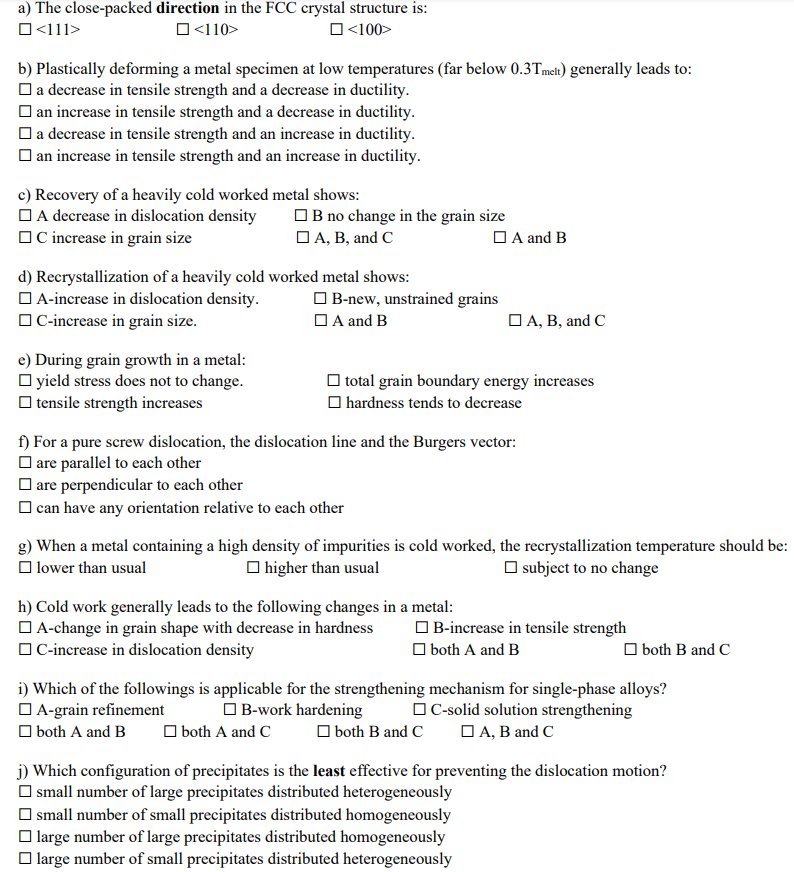
a) The close-packed direction in the FCC crystal structure is: <111><110><100> b) Plastically deforming a metal specimen
Posted: Thu Jul 14, 2022 3:33 pm
by answerhappygod
- A The Close Packed Direction In The Fcc Crystal Structure Is 111 110 100 B Plastically Deforming A Metal Specimen 1 (198.41 KiB) Viewed 42 times
a) The close-packed direction in the FCC crystal structure is: <111><110><100> b) Plastically deforming a metal specimen at low temperatures (far below 0.3 Tmelt ) generally leads to: a decrease in tensile strength and a decrease in ductility. an increase in tensile strength and a decrease in ductility. a decrease in tensile strength and an increase in ductility. an increase in tensile strength and an increase in ductility. c) Recovery of a heavily cold worked metal shows: d) Recrystallization of a heavily cold worked metal shows: A-increase in dislocation density. C-increase in grain size. B-new, unstrained grains A and BA,B, and C e) During grain growth in a metal: yield stress does not to change. total grain boundary energy increases tensile strength increases hardness tends to decrease f) For a pure screw dislocation, the dislocation line and the Burgers vector: are parallel to each other are perpendicular to each other can have any orientation relative to each other g) When a metal containing a high density of impurities is cold worked, the recrystallization temperature should be: lower than usual □ subject to no change h) Cold work generally leads to the following changes in a metal: A-change in grain shape with decrease in hardness C-increase in dislocation density B-increase in tensile strength both A and B both B and C i) Which of the followings is applicable for the strengthening mechanism for single-phase alloys? j) Which configuration of precipitates is the least effective for preventing the dislocation motion? small number of large precipitates distributed heterogeneously small number of small precipitates distributed homogeneously large number of large precipitates distributed homogeneously large number of small precipitates distributed heterogeneously