Page 1 of 1
A lab-scale reactor is set up to process vin=50 L⋅min−1 of a gas stream, containing a generic reactant A with initial c
Posted: Thu Jul 14, 2022 3:32 pm
by answerhappygod
- A Lab Scale Reactor Is Set Up To Process Vin 50 L Min 1 Of A Gas Stream Containing A Generic Reactant A With Initial C 1 (73.06 KiB) Viewed 42 times
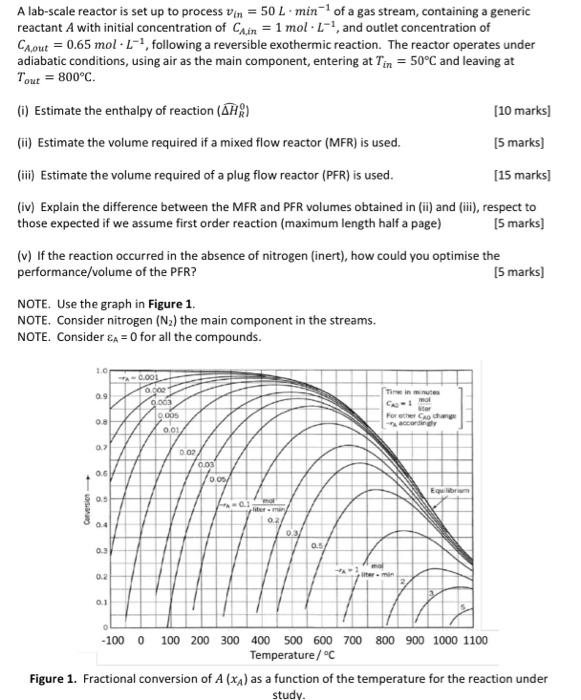
A lab-scale reactor is set up to process vin=50 L⋅min−1 of a gas stream, containing a generic reactant A with initial concentration of CA, in =1 mol⋅L−1, and outlet concentration of CA, out =0.65 mol⋅L−1, following a reversible exothermic reaction. The reactor operates under adiabatic conditions, using air as the main component, entering at Tin=50∘C and leaving at Tout =800∘C (i) Estimate the enthalpy of reaction (ΔHR0) [10 marks] (ii) Estimate the volume required if a mixed flow reactor (MFR) is used. [5 marks] (iii) Estimate the volume required of a plug flow reactor (PFR) is used. [15 marks] (iv) Explain the difference between the MFR and PFR volumes obtained in (ii) and (iii), respect to those expected if we assume first order reaction (maximum length half a page) [5 marks] (v) If the reaction occurred in the absence of nitrogen (inert), how could you optimise the performance/volume of the PFR? [5 marks] NOTE. Use the graph in Figure 1. NOTE. Consider nitrogen (N2) the main component in the streams. NOTE. Consider εA=0 for all the compounds. Figure 1. Fractional conversion of A(xA) as a function of the temperature for the reaction under study.