Page 1 of 1
A way to make artificial diamond is to squeeze carbon atoms under intense pressure: about 725,000 Psi (∼5,000MPa). The i
Posted: Thu Jul 14, 2022 2:45 pm
by answerhappygod
- A Way To Make Artificial Diamond Is To Squeeze Carbon Atoms Under Intense Pressure About 725 000 Psi 5 000mpa The I 1 (296.09 KiB) Viewed 50 times
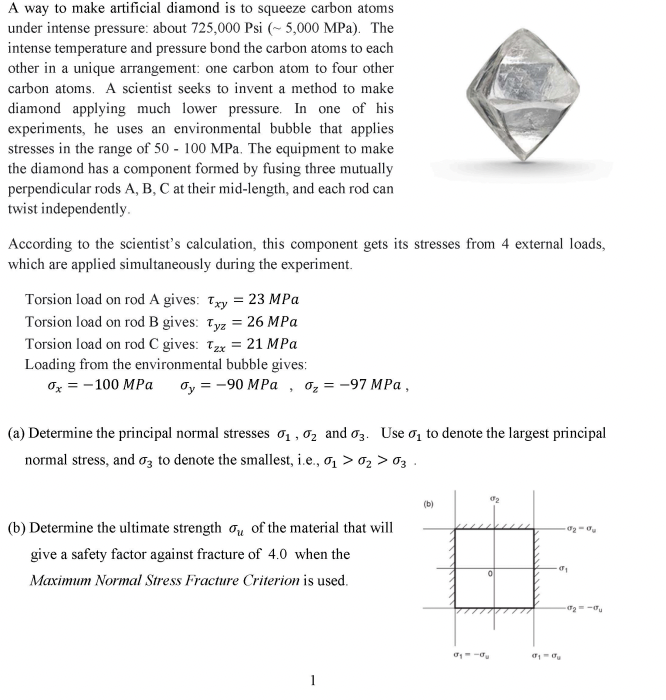
A way to make artificial diamond is to squeeze carbon atoms under intense pressure: about 725,000 Psi (∼5,000MPa). The intense temperature and pressure bond the carbon atoms to each other in a unique arrangement: one carbon atom to four other carbon atoms. A scientist seeks to invent a method to make diamond applying much lower pressure. In one of his experiments, he uses an environmental bubble that applies stresses in the range of 50−100MPa. The equipment to make the diamond has a component formed by fusing three mutually perpendicular rods A,B,C at their mid-length, and each rod can twist independently. According to the scientist's calculation, this component gets its stresses from 4 external loads, which are applied simultaneously during the experiment. Torsion load on rod A gives: τxy=23MPa Torsion load on rod B gives: τyz=26MPa Torsion load on rod C gives: τ2x=21MPa Loading from the environmental bubble gives: σx=−100MPaσy=−90MPa,σz=−97MPa, (a) Determine the principal normal stresses σ1,σ2 and σ3. Use σ1 to denote the largest principal normal stress, and σ3 to denote the smallest, i.e., σ1>σ2>σ3. (b) Determine the ultimate strength σu of the material that will give a safety factor against fracture of 4.0 when the Maximum Normal Stress Fracture Criterion is used.