Page 1 of 1
(f) Express the Equation of Motion in Equation (1) in terms of the displacement θ1(t) about an equilibrium position θe
Posted: Thu Jul 14, 2022 2:45 pm
by answerhappygod
- 1 (212.14 KiB) Viewed 50 times
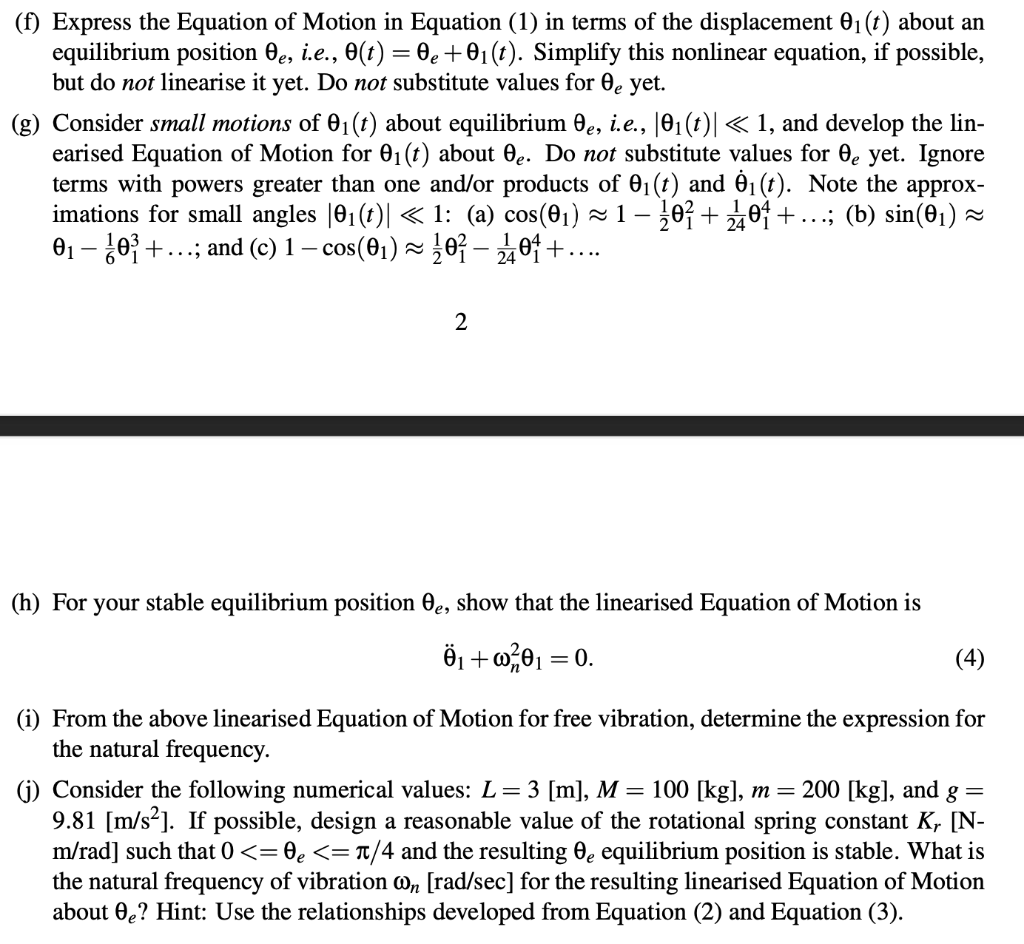
(f) Express the Equation of Motion in Equation (1) in terms of the displacement θ1(t) about an equilibrium position θe, i.e., θ(t)=θe+θ1(t). Simplify this nonlinear equation, if possible, but do not linearise it yet. Do not substitute values for θe yet. (g) Consider small motions of θ1(t) about equilibrium θe, i.e., ∣θ1(t)∣≪1, and develop the linearised Equation of Motion for θ1(t) about θe. Do not substitute values for θe yet. Ignore terms with powers greater than one and/or products of θ1(t) and θ˙1(t). Note the approximations for small angles ∣θ1(t)∣≪1 : (a) cos(θ1)≈1−21θ12+241θ14+…; (b) sin(θ1)≈ θ1−61θ13+…; and (c) 1−cos(θ1)≈21θ12−241θ14+… 5 h) For your stable equilibrium position θe, show that the linearised Equation of Motion is θ¨1+ωn2θ1=0. (i) From the above linearised Equation of Motion for free vibration, determine the expression for the natural frequency. (j) Consider the following numerical values: L=3[ m],M=100 [kg], m=200 [kg], and g= 9.81[ m/s2]. If possible, design a reasonable value of the rotational spring constant Kr[ N− m/rad] such that 0<=θe<=π/4 and the resulting θe equilibrium position is stable. What is the natural frequency of vibration ωn[rad/sec] for the resulting linearised Equation of Motion about θe ? Hint: Use the relationships developed from Equation (2) and Equation (3).
J0θ¨+Krθ−Lg(M+21m)sinθ=0