Page 1 of 1
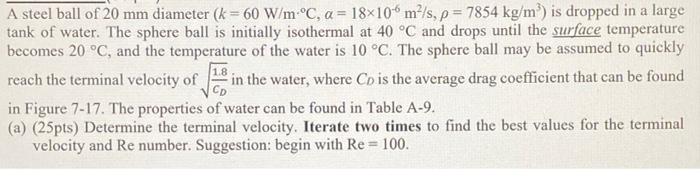
A steel ball of 20 mm diameter (k=60 W/m∘C,α=18×10−6 m2/s,ρ=7854 kg/m3) is dropped in a large tank of water. The sphere
Posted: Thu Jul 14, 2022 2:44 pm
by answerhappygod
- 1 (27.07 KiB) Viewed 38 times

- 2 (10.84 KiB) Viewed 38 times
A steel ball of 20 mm diameter (k=60 W/m∘C,α=18×10−6 m2/s,ρ=7854 kg/m3) is dropped in a large tank of water. The sphere ball is initially isothermal at 40∘C and drops until the surface temperature becomes 20∘C, and the temperature of the water is 10∘C. The sphere ball may be assumed to quickly reach the terminal velocity of CD1.8 in the water, where CD is the average drag coefficient that can be found in Figure 7-17. The properties of water can be found in Table A-9. (a) (25pts) Determine the terminal velocity. Iterate two times to find the best values for the terminal velocity and Re number. Suggestion: begin with R=100.
(b) (25pts) Determine the height of the water tank required to cool the surface of the sphere ball to 20∘C. Use analytical one-term approximation method for the conduction heat transfer.