Page 1 of 1
Consider the fluid flow in the channel sketched in figure Q1. The channel has an infinite extension in the x and z direc
Posted: Thu Jul 14, 2022 2:39 pm
by answerhappygod
- Consider The Fluid Flow In The Channel Sketched In Figure Q1 The Channel Has An Infinite Extension In The X And Z Direc 1 (131.67 KiB) Viewed 47 times
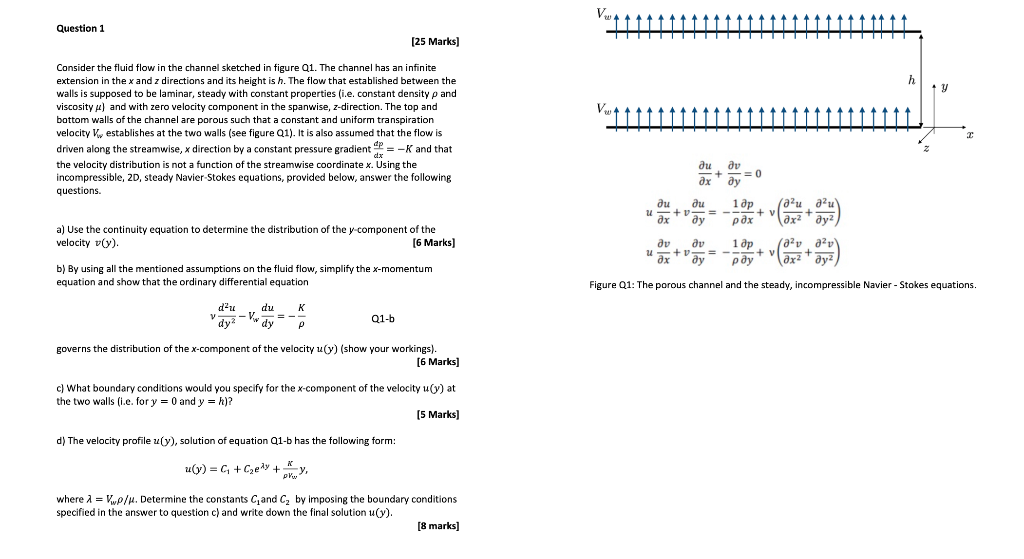
Consider the fluid flow in the channel sketched in figure Q1. The channel has an infinite extension in the x and z directions and its height is h. The flow that established between the walls is supposed to be laminar, steady with constant properties (i.e. constant density ρ and viscosity μ ) and with zero velocity component in the spanwise, z-direction. The top and battom walls of the channel are porous such that a constant and uniform transpiration velocity Vw establishes at the two walls (see figure Q1 ). It is also assumed that the flow is driven along the streamwise, x direction by a constant pressure gradient dxdp=−K and that the velocity distribution is not a function of the streamwise coordinate x. Using the incompressible, 2D, steady Navier-Stokes equations, provided below, answer the following ∂x∂u+∂y∂v=0 questions. u∂x∂u+v∂y∂u=−ρ1∂x∂p+v(∂x2∂2u+∂y2∂2u) a) Use the continuity equation to determine the distribution of the y-component of the [6 Marks] velocity v(y). u∂x∂v+v∂y∂v=−ρ1∂y∂p+v(∂x2∂2v+∂y2∂2v) b) By using all the mentioned assumptions on the fluid flow, simplify the x-momentum Figure Q1: The porous channel and the steady, incompressible Navier - Stokes equations. equation and show that the ordinary differential equation vdy2d2u−Vwdydu=−ρK Q1-b governs the distribution of the x-component of the velocity u(y) (show your workings). [6 Marks] c] What boundary conditions would you specify for the x-component of the velocity u(y) at the two walls (i.e. for y=0 and y=h )? [5 Marks] d) The velocity profile u(y), solution of equation Q1-b has the following form: u(y)=C1+C2eλy+pVwκy, where λ=Vwρ/μ. Determine the constants C1 and C2 by imposing the boundary conditions specified in the answer to question c) and write down the final solution u(y). [8 marks]