Page 1 of 1
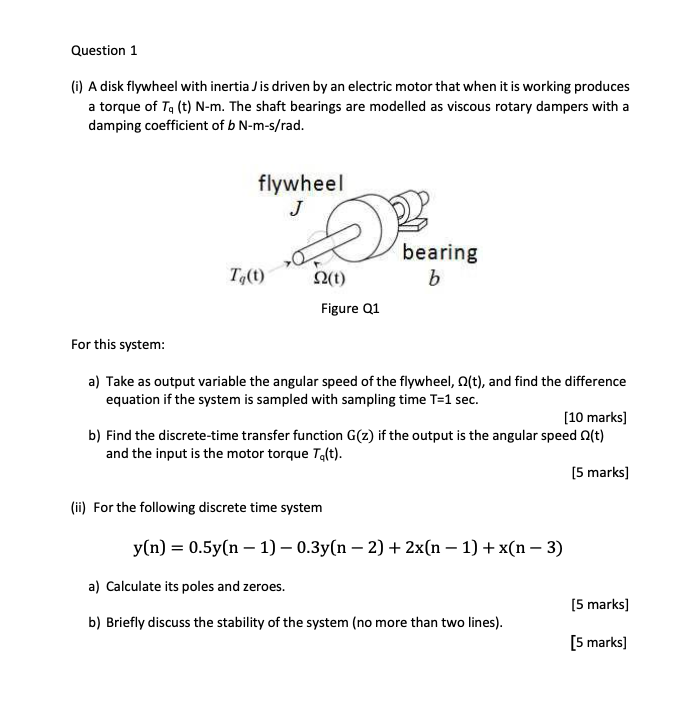
(i) A disk flywheel with inertia J is driven by an electric motor that when it is working produces a torque of Tq(t)N−m
Posted: Thu Jul 14, 2022 2:39 pm
by answerhappygod
- I A Disk Flywheel With Inertia J Is Driven By An Electric Motor That When It Is Working Produces A Torque Of Tq T N M 1 (83.17 KiB) Viewed 41 times
(i) A disk flywheel with inertia J is driven by an electric motor that when it is working produces a torque of Tq(t)N−m. The shaft bearings are modelled as viscous rotary dampers with a damping coefficient of b N−m−s/rad. For this system: a) Take as output variable the angular speed of the flywheel, Ω(t), and find the difference equation if the system is sampled with sampling time T=1 sec. [10 marks] b) Find the discrete-time transfer function G(z) if the output is the angular speed Ω(t) and the input is the motor torque Tq(t). [5 marks] (ii) For the following discrete time system y(n)=0.5y(n−1)−0.3y(n−2)+2x(n−1)+x(n−3)