Page 1 of 1
7. (Surfaces of revolution with negative curvature K = -1/c?) As in the cor- responding positive case, there is a family
Posted: Tue Apr 26, 2022 4:58 pm
by answerhappygod
- 7 Surfaces Of Revolution With Negative Curvature K 1 C As In The Cor Responding Positive Case There Is A Family 1 (65.71 KiB) Viewed 49 times
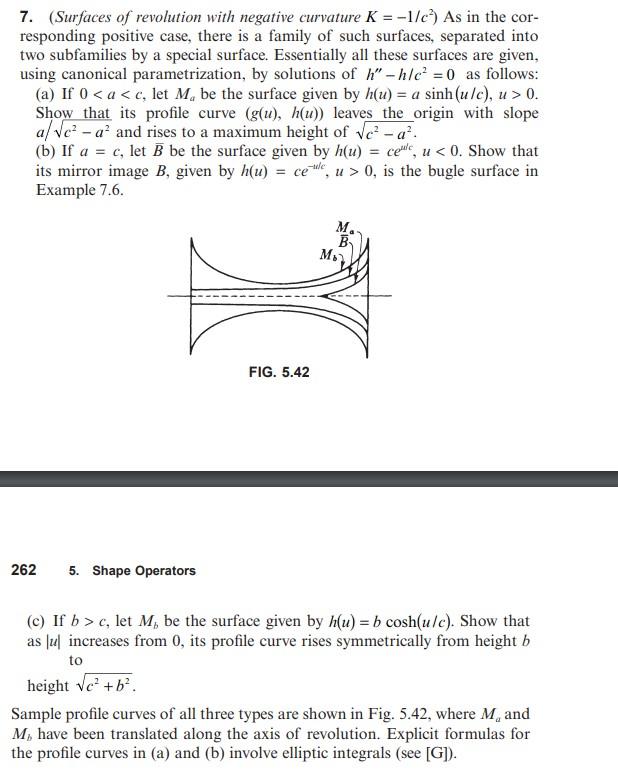
7. (Surfaces of revolution with negative curvature K = -1/c?) As in the cor- responding positive case, there is a family of such surfaces, separated into two subfamilies by a special surface. Essentially all these surfaces are given, using canonical parametrization, by solutions of h" - hle = 0 as follows: (a) If 0 <a<c, let M, be the surface given by h(u) = a sinh (ulc), u > 0. Show that its profile curve (g(u), h(u)) leaves the origin with slope a/ Ne? - a’ and rises to a maximum height of le-a?. (b) If a = c, let B be the surface given by h(u) = cele, u < 0. Show that its mirror image B, given by h(u) = cewe, u > 0, is the bugle surface in Example 7.6. U> M. B M FIG. 5.42 262 5. Shape Operators (c) If b > c, let M, be the surface given by h(u) = b cosh(u/e). Show that as | increases from 0, its profile curve rises symmetrically from height b to height ve+b. Sample profile curves of all three types are shown in Fig. 5.42, where M, and Mhave been translated along the axis of revolution. Explicit formulas for the profile curves in (a) and (b) involve elliptic integrals (see [G]).