Page 1 of 1
1. [10] Let Z+be the set of positive integers. For each x∈Z+, let D(x) denote the set that contains all the divisors of
Posted: Thu Jul 14, 2022 2:07 pm
by answerhappygod
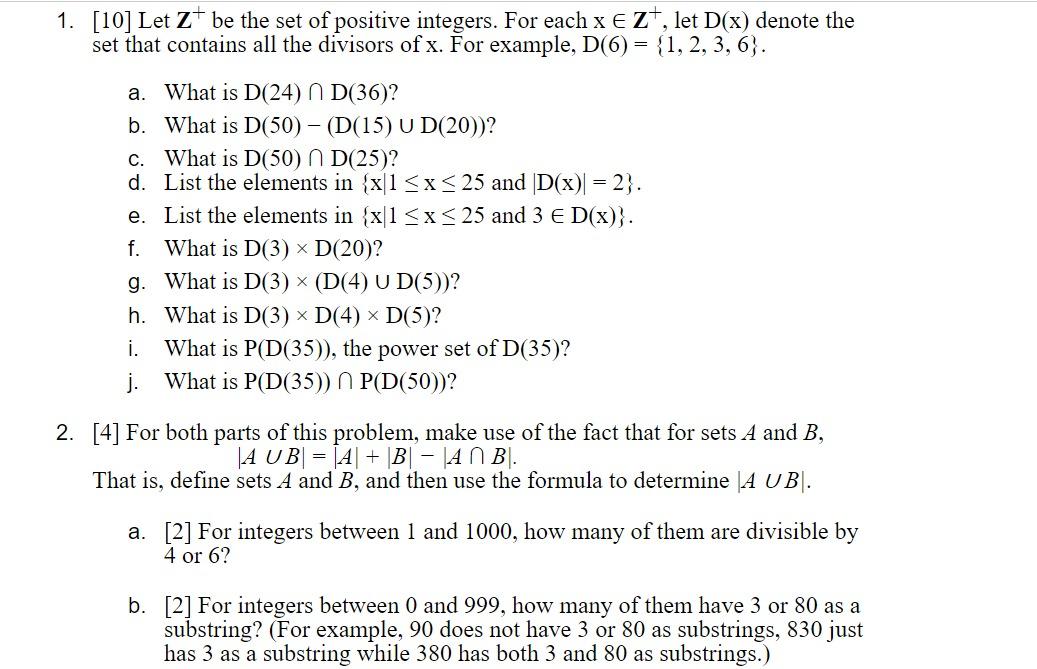
- 1 10 Let Z Be The Set Of Positive Integers For Each X Z Let D X Denote The Set That Contains All The Divisors Of 1 (100.21 KiB) Viewed 46 times
1. [10] Let Z+be the set of positive integers. For each x∈Z+, let D(x) denote the set that contains all the divisors of x. For example, D(6)={1,2,3,6}. a. What is D(24)∩D(36) ? b. What is D(50)−(D(15)∪D(20)) ? c. What is D(50)∩D(25) ? d. List the elements in {x∣1≤x≤25 and ∣D(x)∣=2}. e. List the elements in {x∣1≤x≤25 and 3∈D(x)}. f. What is D(3)×D(20) ? g. What is D(3)×(D(4)∪D(5)) ? h. What is D(3)×D(4)×D(5) ? i. What is P(D(35)), the power set of D(35) ? j. What is P(D(35))∩P(D(50)) ? 2. [4] For both parts of this problem, make use of the fact that for sets A and B, ∣A∪B∣=∣A∣+∣B∣−∣A∩B∣. That is, define sets A and B, and then use the formula to determine ∣A∪B∣. a. [2] For integers between 1 and 1000 , how many of them are divisible by 4 or 6? b. [2] For integers between 0 and 999 , how many of them have 3 or 80 as a substring? (For example, 90 does not have 3 or 80 as substrings, 830 just has 3 as a substring while 380 has both 3 and 80 as substrings.)