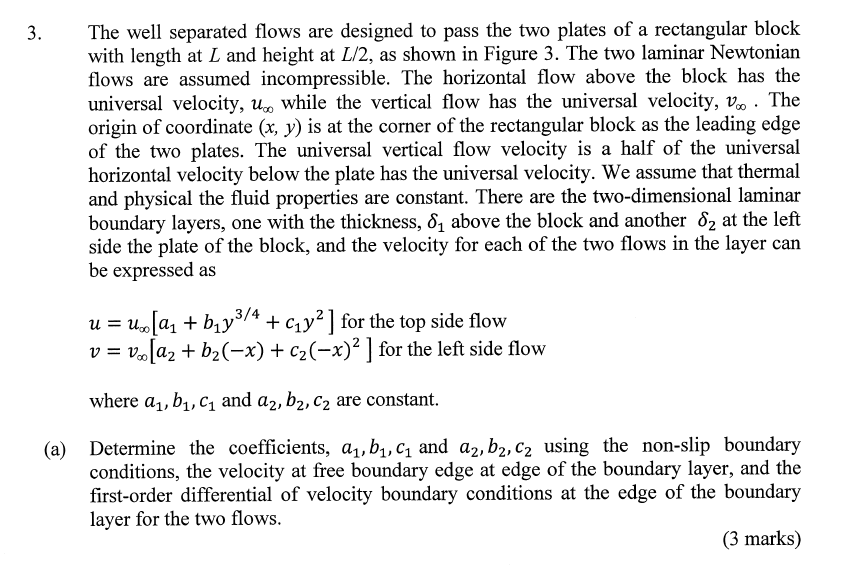
- 3 The Well Separated Flows Are Designed To Pass The Two Plates Of A Rectangular Block With Length At L And Height At L 1 (100.89 KiB) Viewed 29 times
3. The well separated flows are designed to pass the two plates of a rectangular block with length at L and height at L/2, as shown in Figure 3. The two laminar Newtonian flows are assumed incompressible. The horizontal flow above the block has the universal velocity, us while the vertical flow has the universal velocity, vo. The origin of coordinate (x, y) is at the corner of the rectangular block as the leading edge of the two plates. The universal vertical flow velocity is a half of the universal horizontal velocity below the plate has the universal velocity. We assume that thermal and physical the fluid properties are constant. There are the two-dimensional laminar boundary layers, one with the thickness, & above the block and another 82 at the left side the plate of the block, and the velocity for each of the two flows in the layer can be expressed as u= um[a2 + b1y3/4 + c1y] for the top side flow Vo[a2 + b2(-x) + c2(-x)? ] for the left side flow where an, b1, C1 and a2, b2, C2 are constant. (a) Determine the coefficients, dz, b1,C1 and az, b2, C2 using the non-slip boundary conditions, the velocity at free boundary edge at edge of the boundary layer, and the first-order differential of velocity boundary conditions at the edge of the boundary layer for the two flows. (3 marks)
(b) Using the von Karman profile method to solve the integral momentum equation, determine the boundary layer thickness and momentum thickness for the two flows just when each flow leaves the block. (5 marks) (C) Find the velocity component perpendicular to each surface at the boundary layer for the two flows and give the value when each flow leaves the block. (6 marks) (d) Give the total skin friction drag coefficient on each of the two plates which the relative flow passes across. (6 marks) (e) State if there is the same displacement thickness on the block between the two flows at the two walls, and show the derivation. (5 marks) L VS1 ပ် ၊ х TIITTI L 82 Figure 3