Page 1 of 1
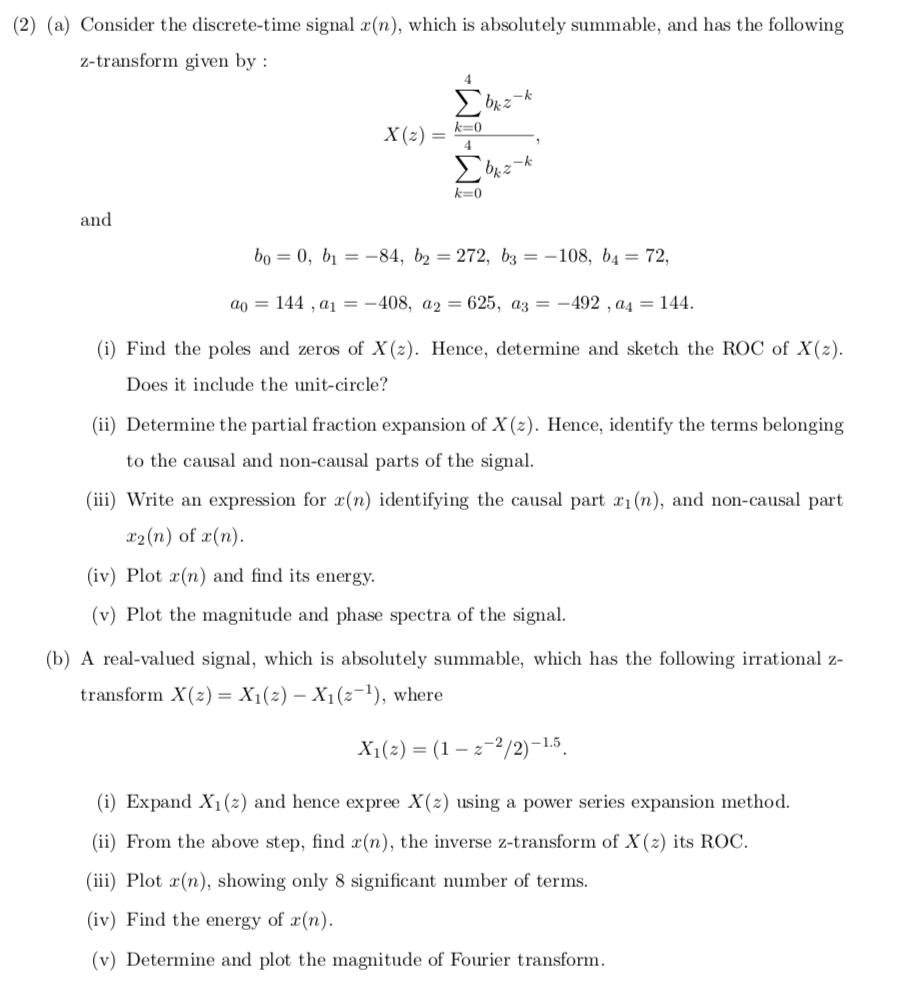
(2) (a) Consider the discrete-time signal x(n), which is absolutely summable, and has the following z-transform given by
Posted: Tue Apr 26, 2022 3:22 pm
by answerhappygod
- 2 A Consider The Discrete Time Signal X N Which Is Absolutely Summable And Has The Following Z Transform Given By 1 (112.02 KiB) Viewed 58 times
(2) (a) Consider the discrete-time signal x(n), which is absolutely summable, and has the following z-transform given by : bkak k=0 X(2) Σομα k=0 and bo = 0, b1 = -84, b2 = 272, b3 = -108, 64 = 72, ao = 144 , aj = -408, a2 = 625, az = -492 , a4 = 144. (i) Find the poles and zeros of X(2). Hence, determine and sketch the ROC of X(2). Does it include the unit-circle? (ii) Determine the partial fraction expansion of X (2). Hence, identify the terms belonging to the causal and non-causal parts of the signal. (iii) Write an expression for x(n) identifying the causal part x1(n), and non-causal part 22(n) of (n). (iv) Plot x(n) and find its energy. (v) Plot the magnitude and phase spectra of the signal. (b) A real-valued signal, which is absolutely summable, which has the following irrational z- transform X(z) = X1(2) - X1(2-1), where X1(z) = (1 – 2-2/2) –1.5. (i) Expand X1(2) and hence expree X(z) using a power series expansion method. (ii) From the above step, find x(n), the inverse z-transform of X (2) its ROC. (iii) Plot x(n), showing only 8 significant number of terms. (iv) Find the energy of x(n). (v) Determine and plot the magnitude of Fourier transform.