Page 1 of 1
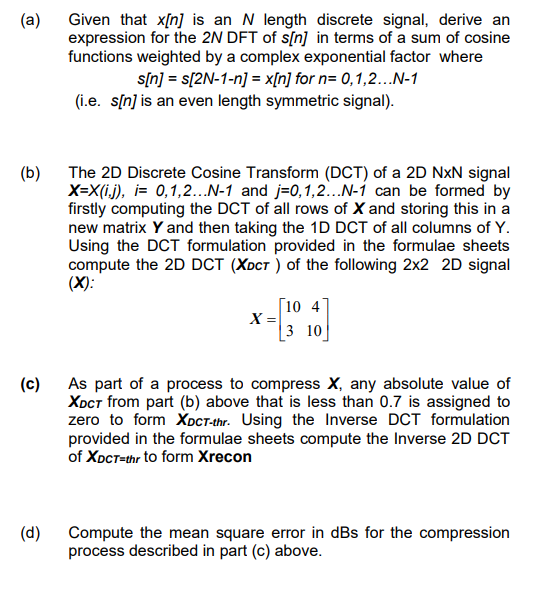
(a) Given that x[n] is an N length discrete signal, derive an expression for the 2N DFT of s[n] in terms of a sum of cos
Posted: Tue Apr 26, 2022 3:00 pm
by answerhappygod
- A Given That X N Is An N Length Discrete Signal Derive An Expression For The 2n Dft Of S N In Terms Of A Sum Of Cos 1 (58.69 KiB) Viewed 48 times
(a) Given that x[n] is an N length discrete signal, derive an expression for the 2N DFT of s[n] in terms of a sum of cosine functions weighted by a complex exponential factor where s[n] = s[2N-1-n] = x[n] for n= 0,1,2...N-1 (i.e. s[n] is an even length symmetric signal). b) (b) The 2D Discrete Cosine Transform (DCT) of a 2D NxN signal X=X(ij), i= 0,1,2...N-1 and j=0,1,2...N-1 can be formed by firstly computing the DCT of all rows of X and storing this in a new matrix Y and then taking the 1D DCT of all columns of Y. Using the DCT formulation provided in the formulae sheets compute the 2D DCT (XDCT ) of the following 2x2 2D signal (X): (10 4 3 10 X= (c) As part of a process to compress X, any absolute value of Xoct from part (b) above that is less than 0.7 is assigned to zero to form XDCT-thr. Using the Inverse DCT formulation provided in the formulae sheets compute the Inverse 2D DCT of XDCT=thr to form Xrecon (d) Compute the mean square error in dBs for the compression process described in part (c) above.