Page 1 of 1
A major problem in the recording of biomedical signals in the USA is the appearance of unwanted 60-Hz interference in th
Posted: Tue Apr 26, 2022 2:59 pm
by answerhappygod
- A Major Problem In The Recording Of Biomedical Signals In The Usa Is The Appearance Of Unwanted 60 Hz Interference In Th 1 (68.4 KiB) Viewed 34 times
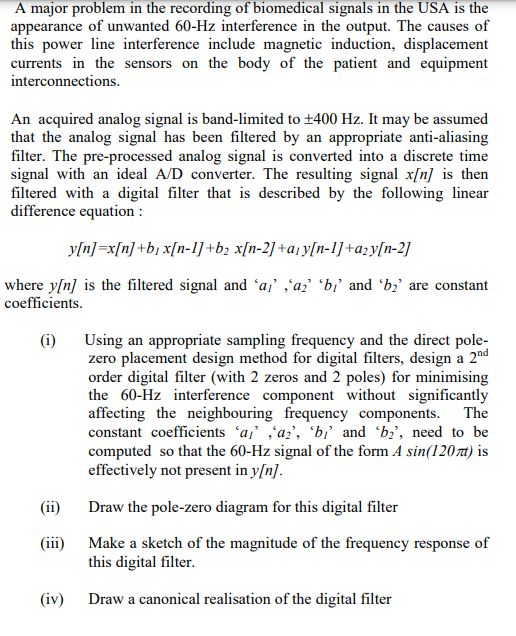
A major problem in the recording of biomedical signals in the USA is the appearance of unwanted 60-Hz interference in the output. The causes of this power line interference include magnetic induction, displacement currents in the sensors on the body of the patient and equipment interconnections. An acquired analog signal is band-limited to +400 Hz. It may be assumed that the analog signal has been filtered by an appropriate anti-aliasing filter. The pre-processed analog signal is converted into a discrete time signal with an ideal A/D converter. The resulting signal x[n] is then filtered with a digital filter that is described by the following linear difference equation : y[n]=x[n] +b) x[n-l] +62 x[n-2] +a1y[n-1]+azy[n-2] where y[n] is the filtered signal and 'ai' ,'a2' 'b' and 'b' are constant coefficients. (1) Using an appropriate sampling frequency and the direct pole- zero placement design method for digital filters, design a 2nd order digital filter (with 2 zeros and 2 poles) for minimising the 60-Hz interference component without significantly affecting the neighbouring frequency components. The constant coefficients 'ai' ,'a2', 'b' and 'b', need to be computed so that the 60-Hz signal of the form A sin(120 ſt) is effectively not present in y[n]. Draw the pole-zero diagram for this digital filter Make a sketch of the magnitude of the frequency response of this digital filter. (ii) (iii) (iv) Draw a canonical realisation of the digital filter