5. Consider the continuous time signal x(t) = exp(j 100nt) + exp(j 150 nt), ost 0
Posted: Tue Apr 26, 2022 2:20 pm
- 5 Consider The Continuous Time Signal X T Exp J 100nt Exp J 150 Nt Ost 0 T 1 To Form Discrete Time Signal X 1 (35.47 KiB) Viewed 43 times
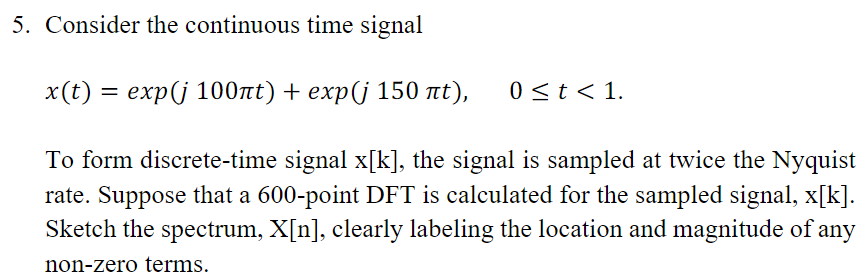
5. Consider the continuous time signal x(t) = exp(j 100nt) + exp(j 150 nt), ost 0 <t < 1. To form discrete-time signal x[k], the signal is sampled at twice the Nyquist rate. Suppose that a 600-point DFT is calculated for the sampled signal, x[k]. Sketch the spectrum, X[n], clearly labeling the location and magnitude of any non-zero terms.
Posted: Tue Apr 26, 2022 2:20 pm
- 5 Consider The Continuous Time Signal X T Exp J 100nt Exp J 150 Nt Ost 0 T 1 To Form Discrete Time Signal X 1 (35.47 KiB) Viewed 43 times