- 3 Use Mathematical Induction To Prove The Following Statements 6 Points Each A For All N N 0 12 22 32 42 1 1 (54 KiB) Viewed 44 times
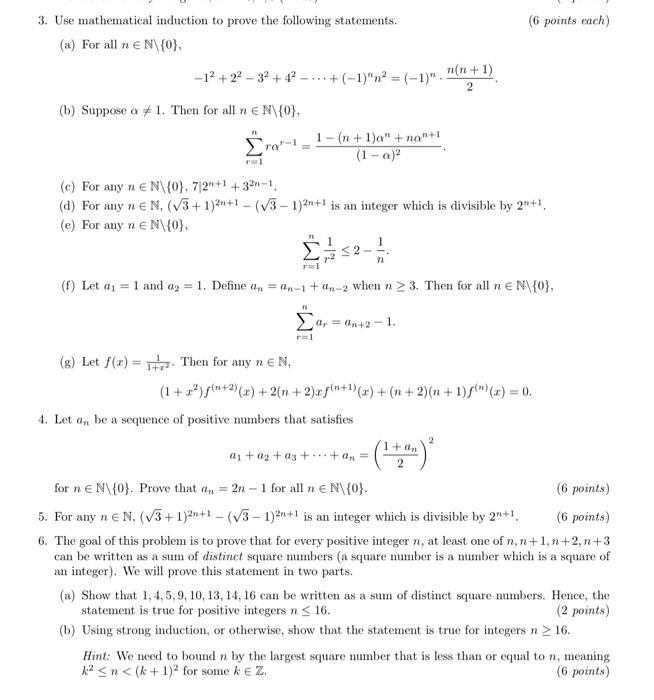
3. Use mathematical induction to prove the following statements. (6 points each) (a) For all n∈N\{0}, −12+22−32+42−⋯+(−1)nn2=(−1)n⋅2n(n+1) (b) Suppose α=1. Then for all n∈N\{0}, r=1∑nrαr−1=(1−α)21−(n+1)αn+nαn+1 (c) For any n∈N\{0},7∣2n+1+32n−1. (d) For any n∈N,(3+1)2n+1−(3−1)2n+1 is an integer which is divisible by 2n+1. (e) For any n∈N\{0}, r=1∑nr21≤2−n1 (f) Let a1=1 and a2=1. Define an=an−1+an−2 when n≥3. Then for all n∈N\{0}, r=1∑nar=an+2−1. (g) Let f(x)=1+x21. Then for any n∈N, (1+x2)f(n+2)(x)+2(n+2)xf(n+1)(x)+(n+2)(n+1)f(n)(x)=0. 4. Let an be a sequence of positive numbers that satisfies a1+a2+a3+⋯+an=(21+an)2 (6 points) for n∈N\{0}. Prove that an=2n−1 for all n∈N\{0}. (6 points) 5. For any n∈N,(3+1)2n+1−(3−1)2n+1 is an integer which is divisible by 2n+1. 6. The goal of this problem is to prove that for every positive integer n, at least one of n,n+1,n+2,n+3 can be written as a sum of distinct square numbers (a square number is a number which is a square of an integer). We will prove this statement in two parts. (a) Show that 1,4,5,9,10,13,14,16 can be written as a sum of distinct square numbers. Hence, the statement is true for positive integers n≤16. (2 points) (b) Using strong induction, or otherwise, show that the statement is true for integers n≥16. Hint: We need to bound n by the largest square number that is less than or equal to n, meaning. k2≤n<(k+1)2 for some k∈Z (6 points)