Page 1 of 1
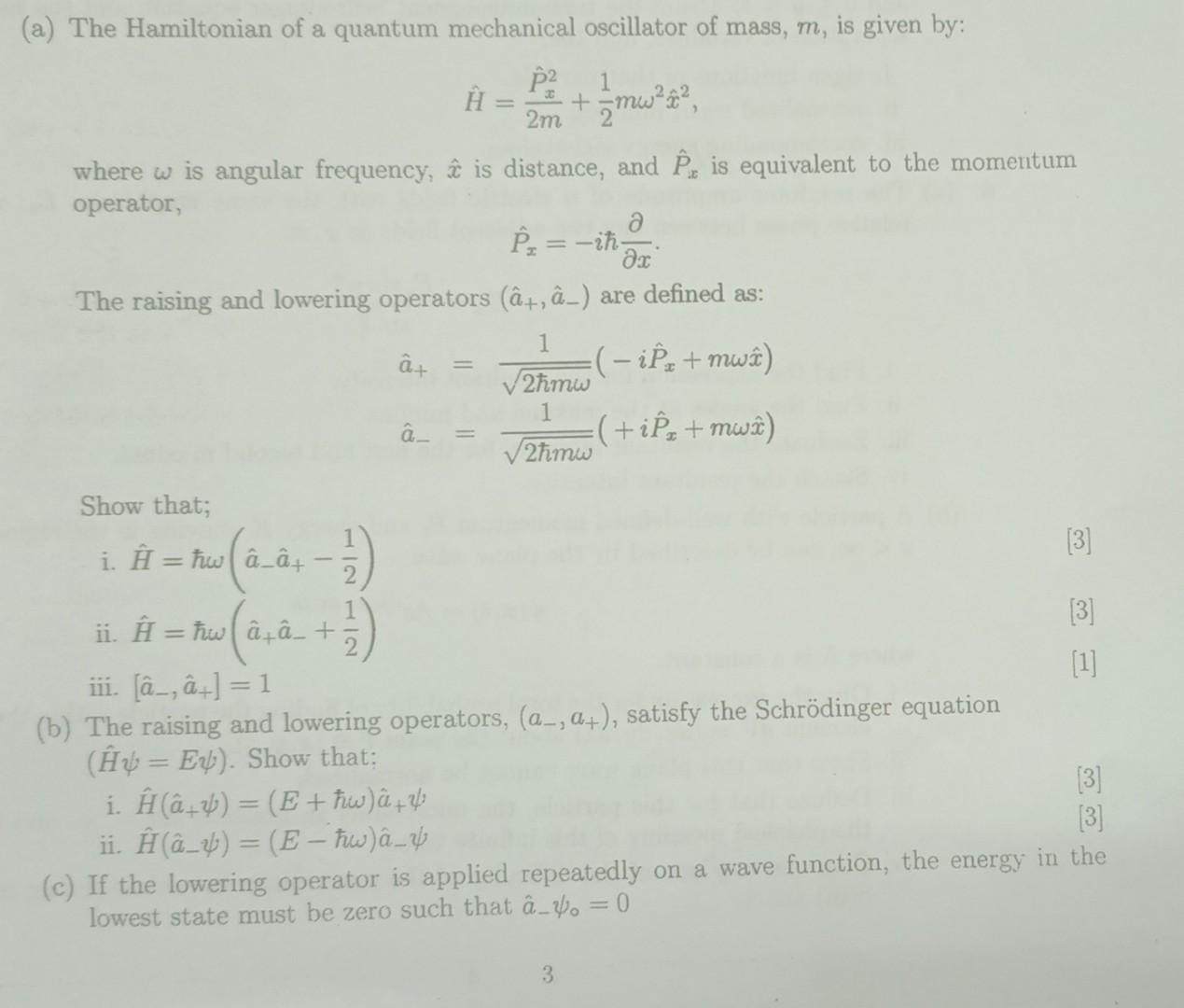
a) The Hamiltonian of a quantum mechanical oscillator of mass, m, is given by: H^=2mP^x2+21mω2x^2, where ω is angular
Posted: Tue Jul 12, 2022 1:40 pm
by answerhappygod
- 1 (69.12 KiB) Viewed 18 times
- 2 (65.24 KiB) Viewed 18 times
a) The Hamiltonian of a quantum mechanical oscillator of mass, m, is given by: H^=2mP^x2+21mω2x^2, where ω is angular frequency, x^ is distance, and P^x is equivalent to the momentum operator, P^x=−iℏ∂x∂ The raising and lowering operators (a^+,a^−)are defined as: a^+=2ℏmω1(−iP^x+mωx^)a^−=2ℏmω1(+iP^x+mωx^) Show that; i. H^=ℏω(a^−a^+−21) ii. H^=ℏω(a^+a^−+21) [3] iii. [a^−,a^+]=1 [3] [1] (b) The raising and lowering operators, (a−,a+), satisfy the Schrödinger equation (H^ψ=Eψ). Show that: i. H^(a^+ψ)=(E+ℏω)a^+ψ ii. H^(a^−ψ)=(E−ℏω)a^−ψ [3] [3] (c) If the lowering operator is applied repeatedly on a wave function, the energy in the lowest state must be zero such that a^−ψ0=0
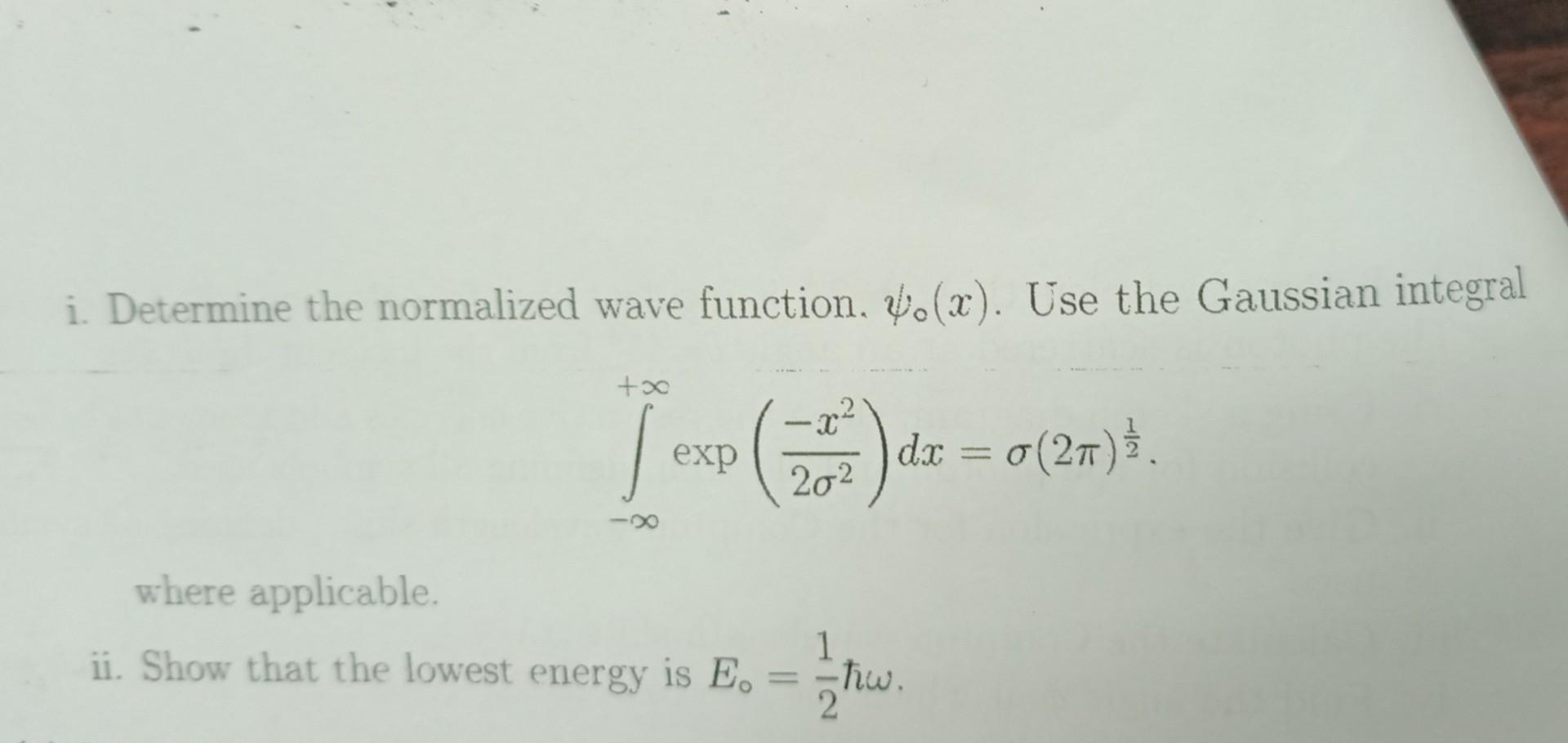
i. Determine the normalized wave function. ψ0(x). Use the Gaussian integral ∫−∞+∞exp(2σ2−x2)dx=σ(2π)21 where applicable. ii. Show that the lowest energy is E∘=21ℏω.