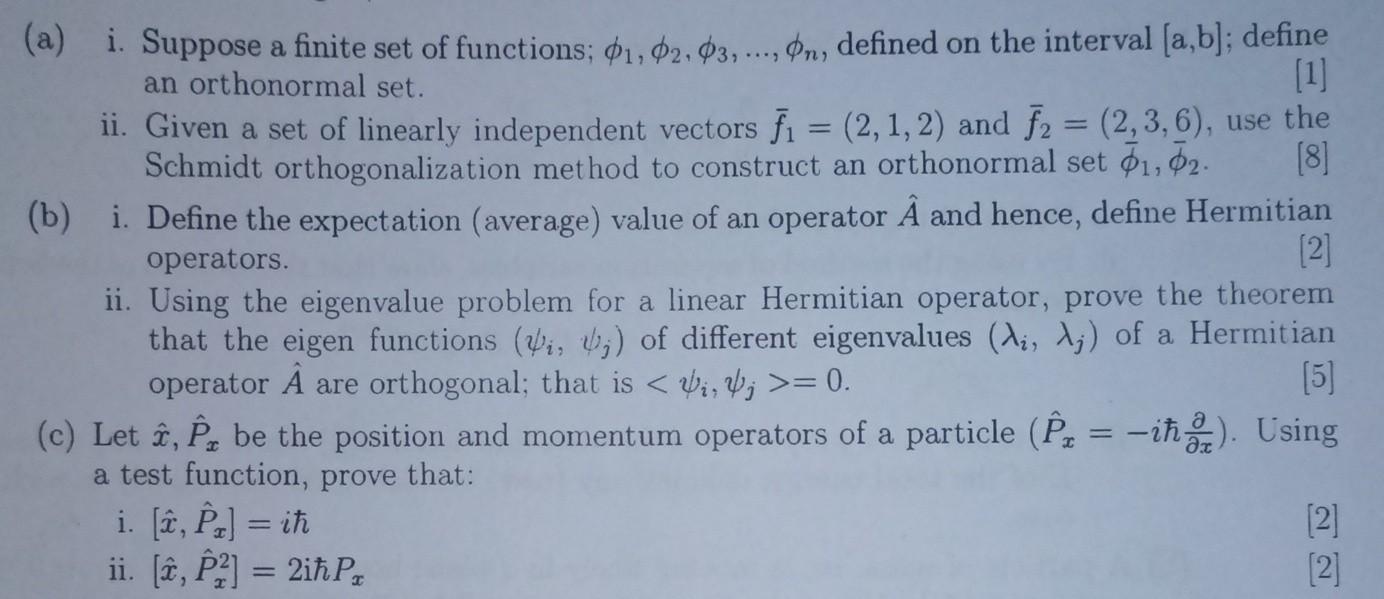
- A I Suppose A Finite Set Of Functions 1 2 3 N Defined On The Interval A B Define An Orthonormal Set 1 1 (80.36 KiB) Viewed 25 times
(a) i. Suppose a finite set of functions; 1, 2, 3, ..., n, defined on the interval [a,b]; define an orthonormal set. [1] ii. Given a set of linearly independent vectors f₁ = (2, 1, 2) and f2 = (2,3,6), use the Schmidt orthogonalization method to construct an orthonormal set 1, 02. [8] (b) i. Define the expectation (average) value of an operator  and hence, define Hermitian operators. [2] ii. Using the eigenvalue problem for a linear Hermitian operator, prove the theorem that the eigen functions (₁, ₁) of different eigenvalues (Ai, Aj) of a Hermitian operator A are orthogonal; that is < V₁, V, >= 0. [5] (c) Let ê, ê, be the position and momentum operators of a particle (P = -ih). Using a test function, prove that: i. [2, Pr] = iħ ii. [â, P²] = 2iħPr [2] [2]