Page 1 of 1
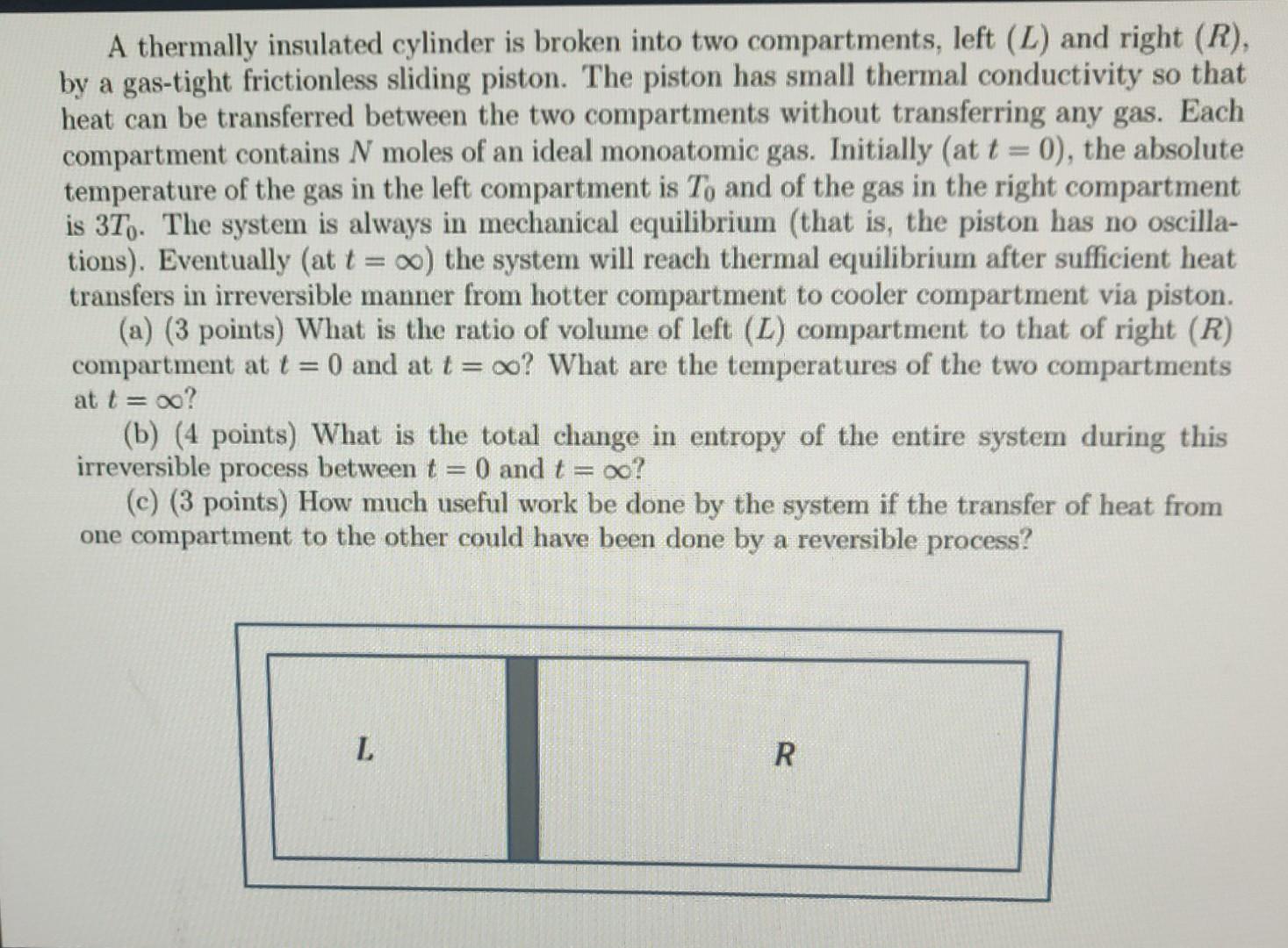
A thermally insulated cylinder is broken into two compartments, left (L) and right (R), by a gas-tight frictionless slid
Posted: Tue Jul 12, 2022 1:35 pm
by answerhappygod
- A Thermally Insulated Cylinder Is Broken Into Two Compartments Left L And Right R By A Gas Tight Frictionless Slid 1 (200.62 KiB) Viewed 43 times
A thermally insulated cylinder is broken into two compartments, left (L) and right (R), by a gas-tight frictionless sliding piston. The piston has small thermal conductivity so that heat can be transferred between the two compartments without transferring any gas. Each compartment contains N moles of an ideal monoatomic gas. Initially (at t = 0), the absolute temperature of the gas in the left compartment is To and of the gas in the right compartment is 3To. The system is always in mechanical equilibrium (that is, the piston has no oscilla- tions). Eventually (at t = ∞o) the system will reach thermal equilibrium after sufficient heat transfers in irreversible manner from hotter compartment to cooler compartment via piston. (a) (3 points) What is the ratio of volume of left (L) compartment to that of right (R) compartment at t = 0 and at t = ∞o? What are the temperatures of the two compartments at t = ∞o? (b) (4 points) What is the total change in entropy of the entire system during this irreversible process between t = 0 and t = 00? (c) (3 points) How much useful work be done by the system if the transfer of heat from one compartment to the other could have been done by a reversible process? L R