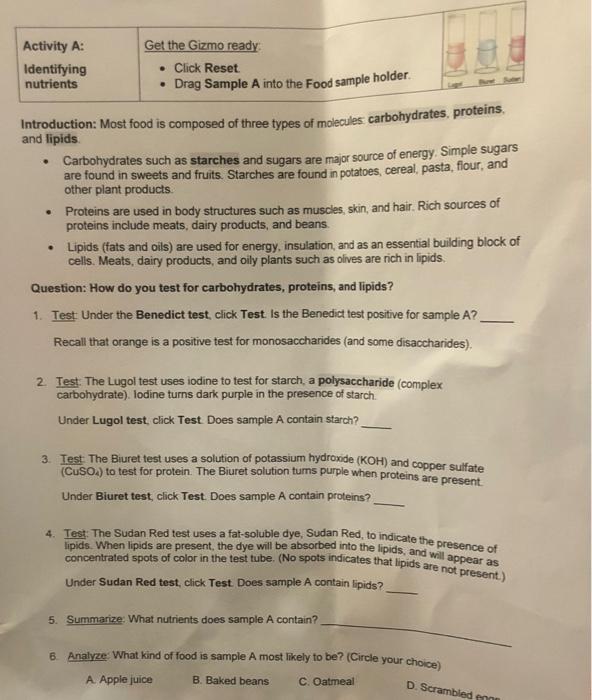
- Activity A Identifying Nutrients Get The Gizmo Ready Click Reset Drag Sample A Into The Food Sample Holder Intro 1 (59 KiB) Viewed 72 times
Activity A: Identifying nutrients Get the Gizmo ready: • Click Reset. • Drag Sample A into the Food sample holder. Introduction: Most food is composed of three types of molecules: carbohydrates, proteins. and lipids. • Carbohydrates such as starches and sugars are major source of energy. Simple sugars are found in sweets and fruits. Starches are found in potatoes, cereal, pasta, flour, and other plant products. • Proteins are used in body structures such as muscles, skin, and hair. Rich sources of proteins include meats, dairy products, and beans. • Lipids (fats and oils) are used for energy, insulation, and as an essential building block of cells. Meats, dairy products, and oily plants such as olives are rich in lipids. Question: How do you test for carbohydrates, proteins, and lipids? 1. Test: Under the Benedict test, click Test. Is the Benedict test positive for sample A? Recall that orange is a positive test for monosaccharides (and some disaccharides). 2. Test: The Lugol test uses iodine to test for starch, a polysaccharide (complex carbohydrate). lodine turns dark purple in the presence of starch. Under Lugol test, click Test Does sample A contain starch? 3. Test: The Biuret test uses a solution of potassium hydroxide (KOH) and copper sulfate (CUSO) to test for protein. The Biuret solution tums purple when proteins are present Under Biuret test, click Test. Does sample A contain proteins? 4. Test: The Sudan Red test uses a fat-soluble dye, Sudan Red, to indicate the presence of lipids. When lipids are present, the dye will be absorbed into the lipids, and will appear as concentrated spots of color in the test tube. (No spots indicates that lipids are not present) Under Sudan Red test, click Test. Does sample A contain lipids? 5. 6. Analyze: What kind of food is sample A most likely to be? (Circle your choice) A. Apple juice B. Baked beans C. Oatmeal Summarize: What nutrients does sample A contain? D. Scrambled enn