Page 1 of 1
3. Patients with Hunter's syndrome or Hurler's syndrome rarely live beyond their teens. Analysis indicates that patients
Posted: Tue Jul 12, 2022 1:18 pm
by answerhappygod
- 3 Patients With Hunter S Syndrome Or Hurler S Syndrome Rarely Live Beyond Their Teens Analysis Indicates That Patients 1 (35.74 KiB) Viewed 51 times
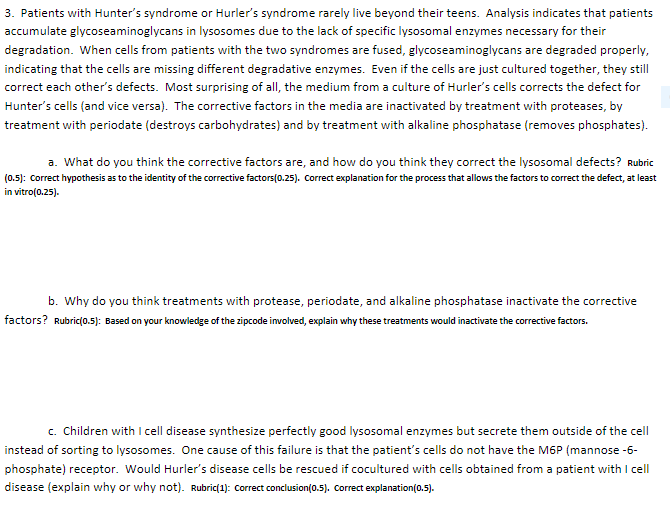
3. Patients with Hunter's syndrome or Hurler's syndrome rarely live beyond their teens. Analysis indicates that patients accumulate glycoseaminoglycans in lysosomes due to the lack of specific lysosomal enzymes necessary for their degradation. When cells from patients with the two syndromes are fused, glycoseaminoglycans are degraded properly, indicating that the cells are missing different degradative enzymes. Even if the cells are just cultured together, they still correct each other's defects. Most surprising of all, the medium from a culture of Hurler's cells corrects the defect for Hunter's cells (and vice versa). The corrective factors in the media are inactivated by treatment with proteases, by treatment with periodate (destroys carbohydrates) and by treatment with alkaline phosphatase (removes phosphates). a. What do you think the corrective factors are, and how do you think they correct the lysosomal defects? Rubric (0.5): Correct hypothesis as to the identity of the corrective factors(0.25). Correct explanation for the process that allows the factors to correct the defect, at least in vitro(0.25). b. Why do you think treatments with protease, periodate, and alkaline phosphatase inactivate the corrective factors? Rubric(0.5): Based on your knowledge of the zipcode involved, explain why these treatments would inactivate the corrective factors. c. Children with I cell disease synthesize perfectly good lysosomal enzymes but secrete them outside of the cell instead of sorting to lysosomes. One cause of this failure is that the patient's cells do not have the M6P (mannose -6- phosphate) receptor. Would Hurler's disease cells be rescued if cocultured with cells obtained from a patient with I cell disease (explain why or why not). Rubric(1): Correct conclusion (0.5). Correct explanation(0.5).