Page 1 of 1
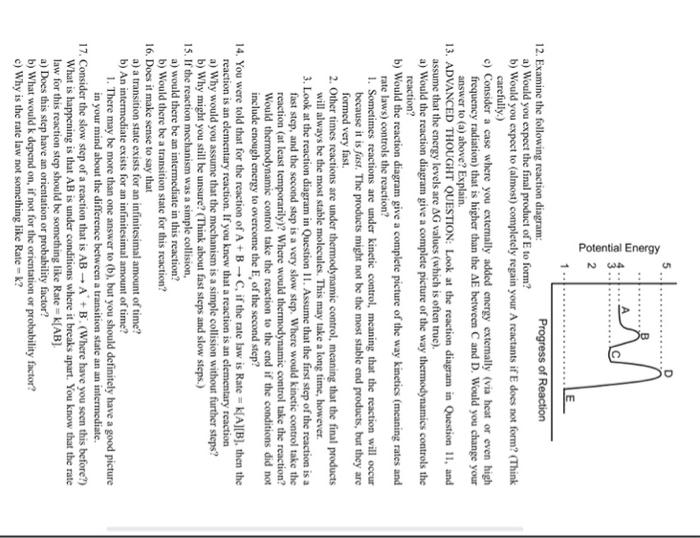
الله Potential Energy 5 43 2 :: Progress of Reaction 12. Examine the following reaction diagram: a) Would you expect the
Posted: Tue Jul 12, 2022 1:09 pm
by answerhappygod
- 1 (71.68 KiB) Viewed 42 times
الله Potential Energy 5 43 2 :: Progress of Reaction 12. Examine the following reaction diagram: a) Would you expect the final product of E to form? b) Would you expect to (almost) completely regain your A reactants if E does not form? (Think carefully.) c) Consider a case where you externally added energy externally (via heat or even high frequency radiation) that is higher than the AE between C and D. Would you change your answer to (a) above? Explain. 13. ADVANCED THOUGHT QUESTION: Look at the reaction diagram in Question 11, and assume that the energy levels are AG values (which is often true). a) Would the reaction diagram give a complete picture of the way thermodynamics controls the reaction? b) Would the reaction diagram give a complete picture of the way kinetics (meaning rates and rate laws) controls the reaction? 1. Sometimes reactions are under kinetic control, meaning that the reaction will occur because it is fast. The products might not be the most stable end products, but they are formed very fast. 2. Other times reactions are under thermodynamic control, meaning that the final products will always be the most stable molecules. This may take a long time, however. 3. Look at the reaction diagram in Question 11. Assume that the first step of the reaction is a fast step, and the second step is a very slow step. Where would kinetic control take the reaction (at least temporarily)? Where would thermodynamic control take the reaction? Would thermodynamic control take the reaction to the end if the conditions did not include enough energy to overcome the E, of the second step? 14. You were told that for the reaction of A+B-C, if the rate law is Rate = K[A]
, then the reaction is an elementary reaction. If you knew that a reaction is an elementary reaction a) Why would you assume that the mechanism is a simple collision without further steps? b) Why might you still be unsure? (Think about fast steps and slow steps.) 15. If the reaction mechanism was a simple collision, a) would there be an intermediate in this reaction? b) Would there be a transition state for this reaction? 16. Does it make sense to say that a) a transition state exists for an infinitesimal amount of time? b) An intermediate exists for an infinitesimal amount of time? 1. There may be more than one answer to (b), but you should definitely have a good picture in your mind about the difference between a transition state an an intermediate. 17. Consider the slow step of a reaction that is AB A+B. (Where have you seen this before?) What is happening is that AB is under conditions where it breaks apart. You know that the rate law for this reaction step should be something like Rate = K[AB] a) Does this step have an orientation or probability factor? b) What would k depend on, if not for the orientation or probability factor? c) Why is the rate law not something like Rate - k?