Page 1 of 1
(a) The voltage, V, in a circuit is given by V=3R3−135R2+1800R+200 where R is the resistance in kΩ. (i) Compute dRdV. (
Posted: Tue Jul 12, 2022 12:47 pm
by answerhappygod
- 1 (103.36 KiB) Viewed 35 times
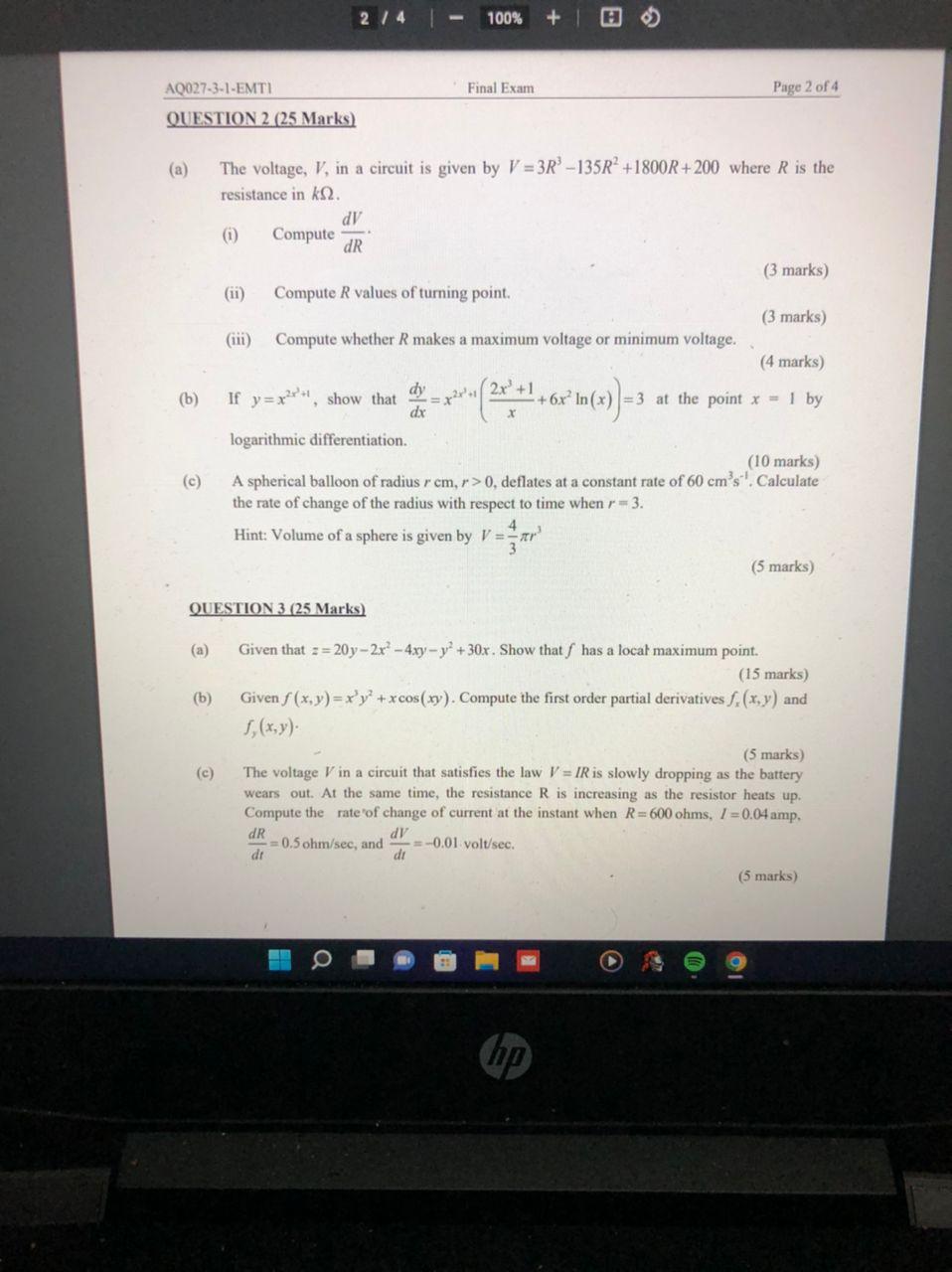
(a) The voltage, V, in a circuit is given by V=3R3−135R2+1800R+200 where R is the resistance in kΩ. (i) Compute dRdV. (3 marks) (ii) Compute R values of turning point. (3 marks) (iii) Compute whether R makes a maximum voltage or minimum voltage. (4 marks) (b) If y=x2x2+1, show that dxdy=x2x2+1(x2x3+1+6x2ln(x))=3 at the point x=1 by logarithmic differentiation. (c) A spherical balloon of radius r cm,r>0, deflates at a constant rate of 60 cm3 s−1. Calculate the rate of change of the radius with respect to time when r=3. Hint: Volume of a sphere is given by V=34πr3 (5 marks) QUESTION 3 (25 Marks) (a) Given that z=20y−2x2−4xy−y2+30x. Show that f has a local maximum point. (15 marks) (b) Given f(x,y)=x3y2+xcos(xy). Compute the first order partial derivatives fx(x,y) and fy(x,y). (5 marks) (c) The voltage V in a circuit that satisfies the law V=IR is slowly dropping as the battery wears out. At the same time, the resistance R is increasing as the resistor heats up. Compute the rate of change of current at the instant when R=600ohms,I=0.04amp. dtdR=0.5ohm/sec, and dtdV=−0.01 volt /sec. (5 marks)