- 2 Prove That For Any Integer N N 0 1 8 Mod9 3 Use Mathematical Induction To Prove The Following Statements A 1 (53.89 KiB) Viewed 26 times

- 2 Prove That For Any Integer N N 0 1 8 Mod9 3 Use Mathematical Induction To Prove The Following Statements A 2 (53.89 KiB) Viewed 26 times
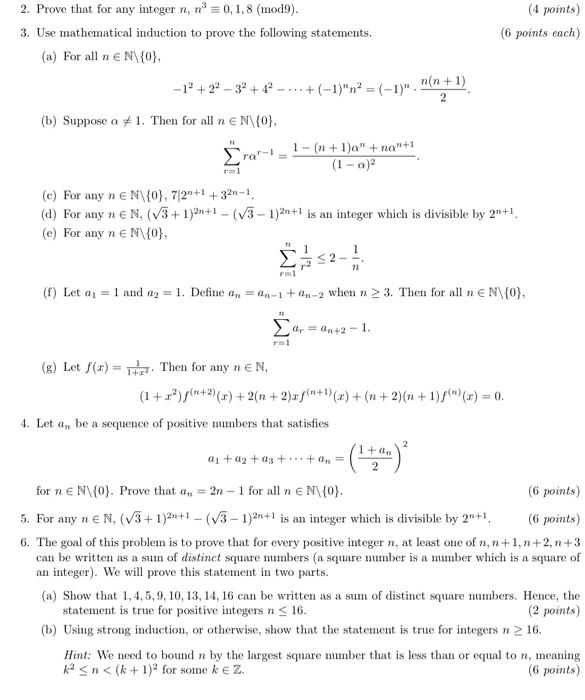
2. Prove that for any integer n, n³ = 0, 1,8 (mod9). 3. Use mathematical induction to prove the following statements. (a) For all n E N\{0}, -1² +2²-3² +4² + (-1)"n² = (-1)", n(n+1) 2 (b) Suppose a 1. Then for all n E N\{0}, 71 r=1 = (g) Let f(r). Then for any nEN, (c) For any neN\{0}, 7/2"+1+32-1, (d) For any n € N, (√3+1)2n+1-(√3-1)2n+1 is an integer which is divisible by 2"+1, (e) For any n € N\{0}, 1-(n+1)a"+na"+1 (1-a)² TI Σ ral (f) Let a₁ = 1 and a2 1. Define anan-1+an-2 when n ≥ 3. Then for all n N\{0}, ar=an+2 -1. TE Σ 7=1 (4 points) (6 points each) 72 4. Let a,, be a sequence of positive numbers that satisfies (1+²) f(+2)(x) + 2(n+2)af(n+¹)(a) + (n + 2)(n+1)f)(x) = 0. 1+ an 2 a₁ + a₂ + a3 + + an = for ne N\{0}. Prove that a, = 2n-1 for all n € N\{0}. (6 points) (6 points) 5. For any n € N, (√3+1)2n+1-(√3-1)2+1 is an integer which is divisible by 2n+1 6. The goal of this problem is to prove that for every positive integer n, at least one of n, n+1, n+2, n+3. can be written as a sum of distinct square numbers (a square number is a number which is a square of an integer). We will prove this statement in two parts. (a) Show that 1, 4, 5, 9, 10, 13, 14, 16 can be written as a sum of distinct square numbers. Hence, the statement is true for positive integers n ≤ 16. (2 points) (b) Using strong induction, or otherwise, show that the statement is true for integers n ≥ 16. Hint: We need to bound n by the largest square number that is less than or equal to n, meaning k²