Page 1 of 1
U(x)=A(1−e−α(x−x0))2 where A is the molecular dissociation energy, α is related to the width of the potential, x is the
Posted: Tue Jul 12, 2022 12:40 pm
by answerhappygod
- 1 (74.38 KiB) Viewed 41 times
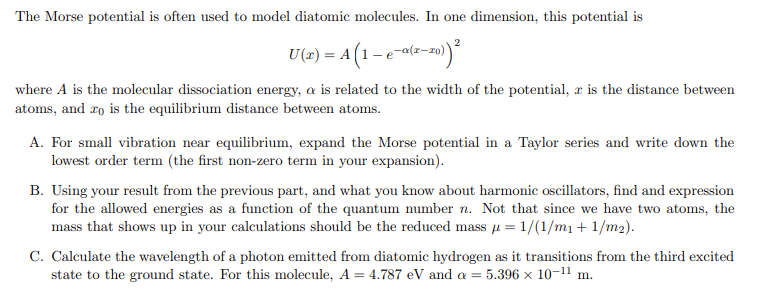
U(x)=A(1−e−α(x−x0))2 where A is the molecular dissociation energy, α is related to the width of the potential, x is the distance between atoms, and x0 is the equilibrium distance between atoms. A. For small vibration near equilibrium, expand the Morse potential in a Taylor series and write down the lowest order term (the first non-zero term in your expansion). B. Using your result from the previous part, and what you know about harmonic oscillators, find and expression for the allowed energies as a function of the quantum number n. Not that since we have two atoms, the mass that shows up in your calculations should be the reduced mass μ=1/(1/m1+1/m2). C. Calculate the wavelength of a photon emitted from diatomic hydrogen as it transitions from the third excited state to the ground state. For this molecule, A=4.787eV and α=5.396×10⁻¹¹ m.