Page 1 of 1
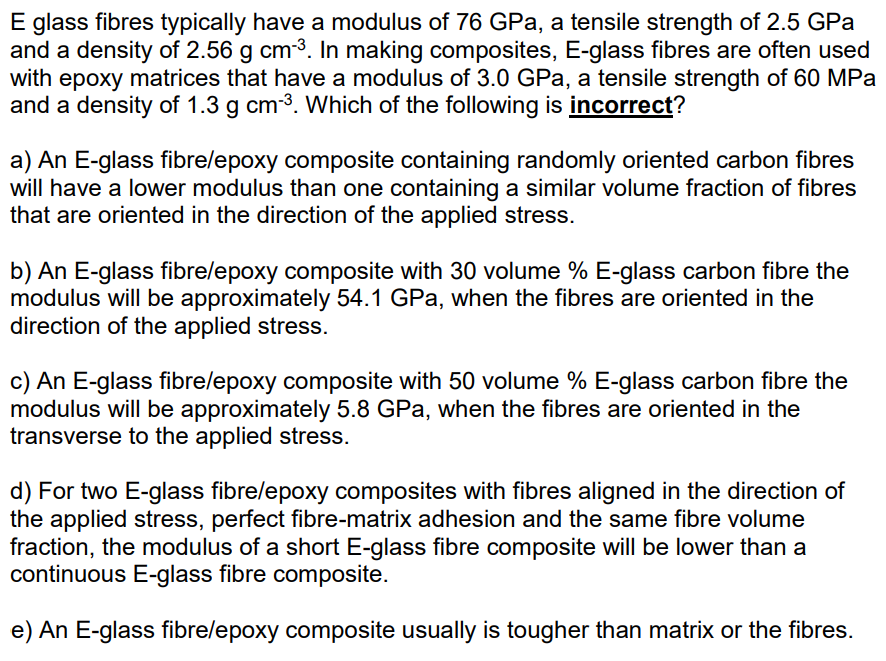
E glass fibres typically have a modulus of 76 GPa, a tensile strength of 2.5 GPa and a density of 2.56 g cm-³. In making
Posted: Tue Jun 07, 2022 5:43 pm
by answerhappygod
- E Glass Fibres Typically Have A Modulus Of 76 Gpa A Tensile Strength Of 2 5 Gpa And A Density Of 2 56 G Cm In Making 1 (201.82 KiB) Viewed 43 times
E glass fibres typically have a modulus of 76 GPa, a tensile strength of 2.5 GPa and a density of 2.56 g cm-³. In making composites, E-glass fibres are often used with epoxy matrices that have a modulus of 3.0 GPa, a tensile strength of 60 MPa and a density of 1.3 g cm-³. Which of the following is incorrect? a) An E-glass fibre/epoxy composite containing randomly oriented carbon fibres will have a lower modulus than one containing a similar volume fraction of fibres that are oriented in the direction of the applied stress. b) An E-glass fibre/epoxy composite with 30 volume % E-glass carbon fibre the modulus will be approximately 54.1 GPa, when the fibres are oriented in the direction of the applied stress. c) An E-glass fibre/epoxy composite with 50 volume % E-glass carbon fibre the modulus will be approximately 5.8 GPa, when the fibres are oriented in the transverse to the applied stress. d) For two E-glass fibre/epoxy composites with fibres aligned in the direction of the applied stress, perfect fibre-matrix adhesion and the same fibre volume fraction, the modulus of a short E-glass fibre composite will be lower than a continuous E-glass fibre composite. e) An E-glass fibre/epoxy composite usually is tougher than matrix or the fibres.