Page 1 of 1
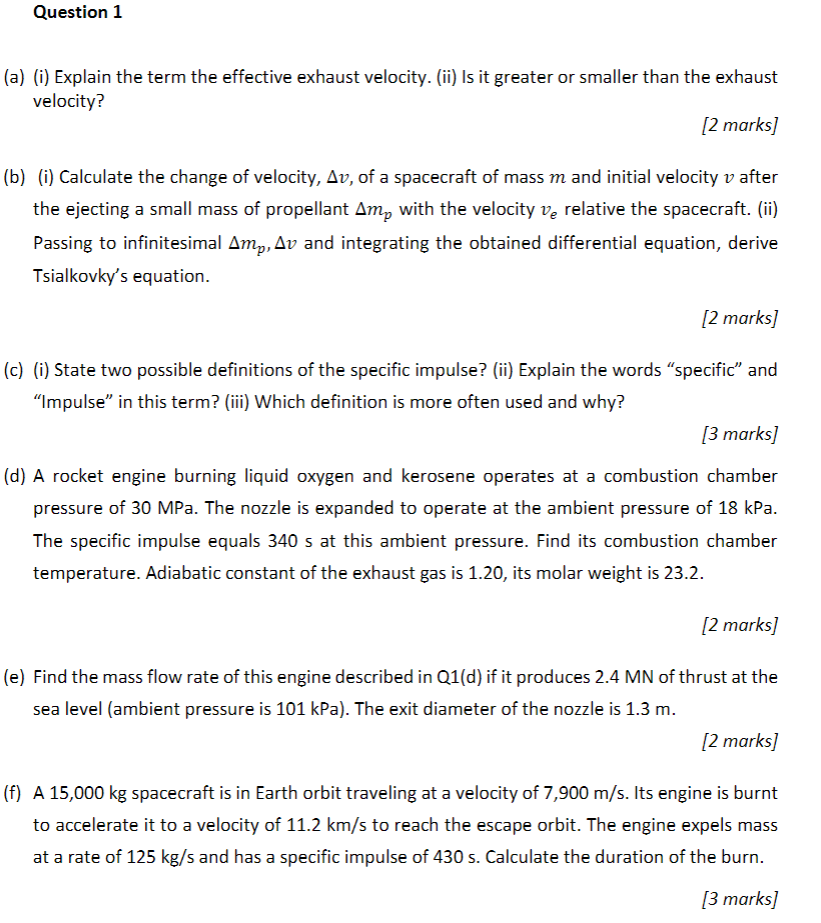
Question 1 (a) (i) Explain the term the effective exhaust velocity. (ii) Is it greater or smaller than the exhaust veloc
Posted: Thu May 26, 2022 11:19 am
by answerhappygod
- Question 1 A I Explain The Term The Effective Exhaust Velocity Ii Is It Greater Or Smaller Than The Exhaust Veloc 1 (160.45 KiB) Viewed 47 times
Question 1 (a) (i) Explain the term the effective exhaust velocity. (ii) Is it greater or smaller than the exhaust velocity? [2 marks] (b) (i) Calculate the change of velocity, Av, of a spacecraft of mass m and initial velocity v after the ejecting a small mass of propellant Amp with the velocity v relative the spacecraft. (ii) Passing to infinitesimal Amp, Av and integrating the obtained differential equation, derive Tsialkovky's equation. [2 marks] (c) (i) State two possible definitions of the specific impulse? (ii) Explain the words "specific" and "Impulse" in this term? (iii) Which definition is more often used and why? [3 marks] (d) A rocket engine burning liquid oxygen and kerosene operates at a combustion chamber pressure of 30 MPa. The nozzle is expanded to operate at the ambient pressure of 18 kPa. The specific impulse equals 340 s at this ambient pressure. Find its combustion chamber temperature. Adiabatic constant of the exhaust gas is 1.20, its molar weight is 23.2. [2 marks] (e) Find the mass flow rate of this engine described in Q1(d) if it produces 2.4 MN of thrust at the sea level (ambient pressure is 101 kPa). The exit diameter of the nozzle is 1.3 m. [2 marks] (f) A 15,000 kg spacecraft is in Earth orbit traveling at a velocity of 7,900 m/s. Its engine is burnt to accelerate it to a velocity of 11.2 km/s to reach the escape orbit. The engine expels mass at a rate of 125 kg/s and has a specific impulse of 430 s. Calculate the duration of the burn. [3 marks]