Page 1 of 1
In binary baseband communication system given in Figure 3, equiprobable 0 and 1 bits are transmitted with $₁ (1) = 0, 0≤
Posted: Thu May 26, 2022 10:30 am
by answerhappygod
- In Binary Baseband Communication System Given In Figure 3 Equiprobable 0 And 1 Bits Are Transmitted With 1 0 0 1 (100.81 KiB) Viewed 32 times
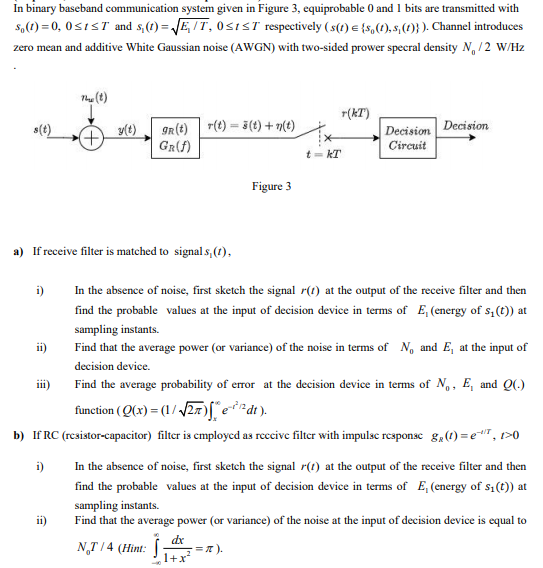
In binary baseband communication system given in Figure 3, equiprobable 0 and 1 bits are transmitted with $₁ (1) = 0, 0≤1≤T and s₁ (t)=√√E/T, 0≤t≤T respectively (s(t) = {s, (1), s, (1)}). Channel introduces zero mean and additive White Gaussian noise (AWGN) with two-sided prower specral density N₁ /2 W/Hz The (1) r(KT) s(t) gr(t) r(t)=3(t) + n(t) (+ Decision Decision Circuit GR(f) Figure 3 a) If receive filter is matched to signals, (1), i) In the absence of noise, first sketch the signal r(t) at the output of the receive filter and then find the probable values at the input of decision device in terms of E, (energy of s₁ (t)) at sampling instants. ii) Find that the average power (or variance) of the noise in terms of N, and E, at the input of decision device. 111) Find the average probability of error at the decision device in terms of N₁, E, and Q(.) function (Q(x) = (1/√√27)[edt). b) If RC (resistor-capacitor) filter is employed as receive filter with impulse response g₂(1)=e¹¹, 1>0 i) In the absence of noise, first sketch the signal r(t) at the output of the receive filter and then find the probable values at the input of decision device in terms of E, (energy of S₁ (t)) at sampling instants. ii) Find that the average power (or variance) of the noise at the input of decision device is equal to NT/4 (Hint: dx 1+x² = π). y(k) t-kT