Page 1 of 1
1. Consider a bouncing ball. At time t = 0, the ball is dropped from a height y(0) = ho, where he is the initial height
Posted: Fri May 20, 2022 6:57 pm
by answerhappygod
- 1 Consider A Bouncing Ball At Time T 0 The Ball Is Dropped From A Height Y 0 Ho Where He Is The Initial Height 1 (95.95 KiB) Viewed 54 times
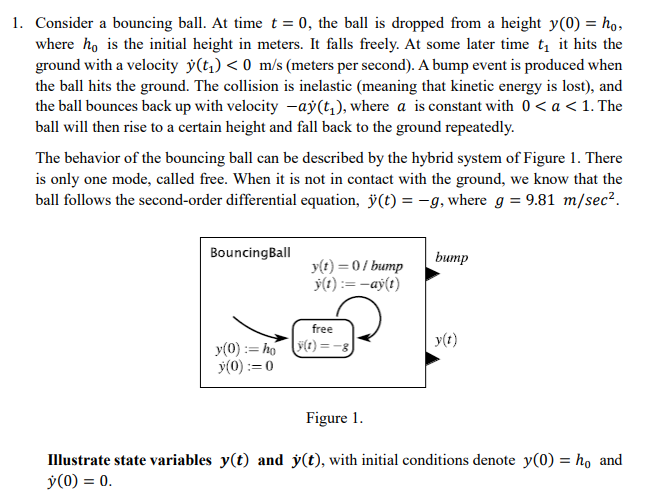
1. Consider a bouncing ball. At time t = 0, the ball is dropped from a height y(0) = ho, where he is the initial height in meters. It falls freely. At some later time tį it hits the ground with a velocity y(t) < 0 m/s (meters per second). A bump event is produced when the ball hits the ground. The collision is inelastic (meaning that kinetic energy is lost), and the ball bounces back up with velocity -ay(tu), where a is constant with 0 < a < 1. The ball will then rise to a certain height and fall back to the ground repeatedly. The behavior of the bouncing ball can be described by the hybrid system of Figure 1. There is only one mode, called free. When it is not in contact with the ground, we know that the ball follows the second-order differential equation, y(t) = -g, where g = 9.81 m/sec2. Bouncing Ball bump y(t) =0 / bump j(t):=-ay(t) free y(t) = -8 y(t) y(0) := họ y(0) :=0 Figure 1. Illustrate state variables y(t) and y(t), with initial conditions denote y(0) = h, and ý(0) = 0.