Page 1 of 1
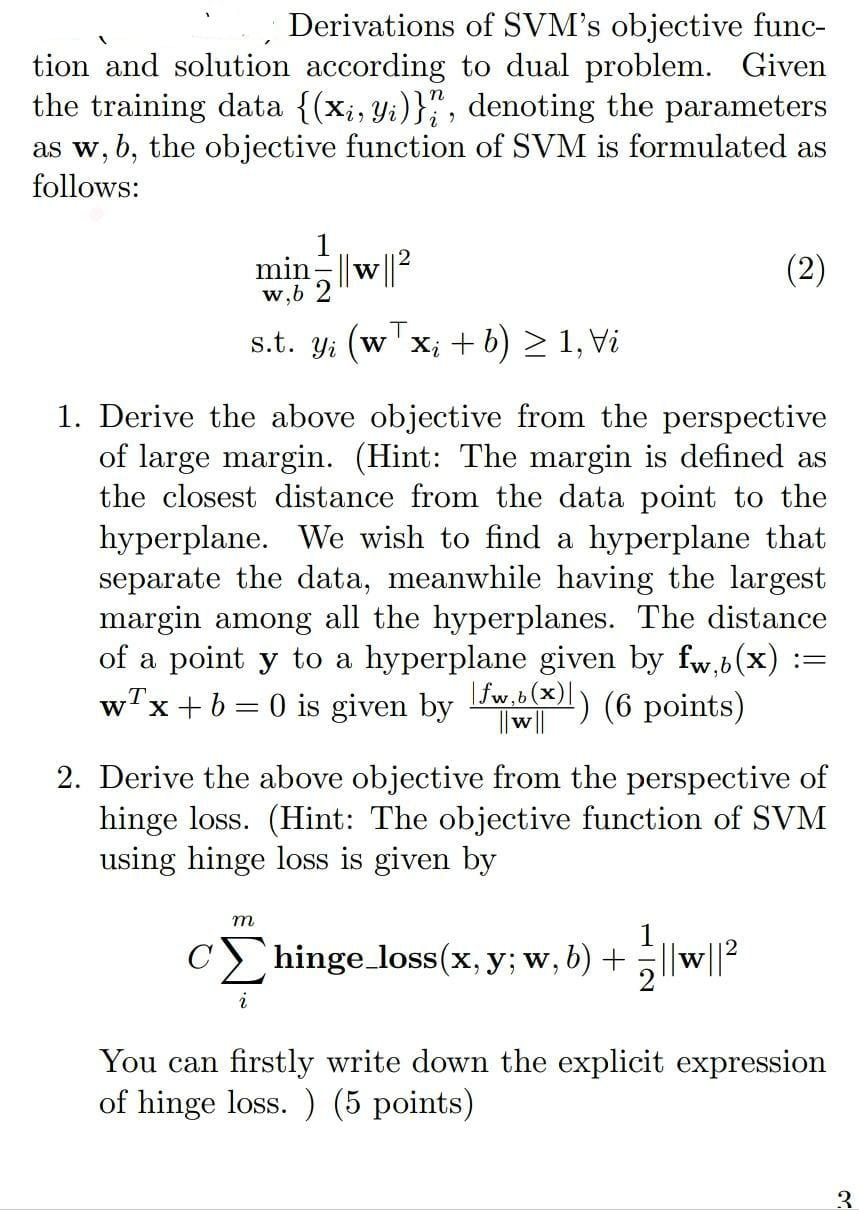
Derivations of SVM's objective func- tion and solution according to dual problem. Given the training data {(x,y:)}, deno
Posted: Fri May 20, 2022 6:43 pm
by answerhappygod
- Derivations Of Svm S Objective Func Tion And Solution According To Dual Problem Given The Training Data X Y Deno 1 (136.47 KiB) Viewed 34 times
- Derivations Of Svm S Objective Func Tion And Solution According To Dual Problem Given The Training Data X Y Deno 2 (48.11 KiB) Viewed 34 times
Derivations of SVM's objective func- tion and solution according to dual problem. Given the training data {(x,y:)}, denoting the parameters as w, b, the objective function of SVM is formulated as follows: 29 2 (2) 1 min||w||2 w,6 2 s.t. Yi (w xi +b) > 1, Vi T 2 1. Derive the above objective from the perspective of large margin. (Hint: The margin is defined as the closest distance from the data point to the hyperplane. We wish to find a hyperplane that separate the data, meanwhile having the largest margin among all the hyperplanes. The distance of a point y to a hyperplane given by fw,6(x) w+x+b = 0) is given by twe(x)) (6 points) 2. Derive the above objective from the perspective of hinge loss. (Hint: The objective function of SVM using hinge loss is given by = m Chinge_loss(x,y;w,b) + 3 ||w| 12 i You can firstly write down the explicit expression of hinge loss. ) (5 points)
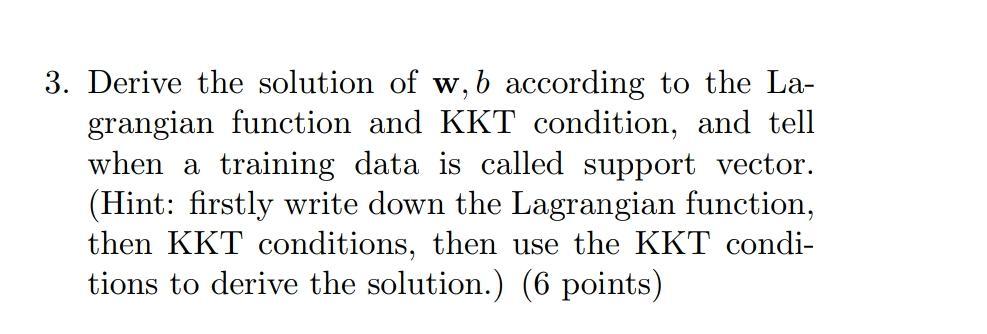
3. Derive the solution of w, b according to the La- grangian function and KKT condition, and tell when a training data is called support vector. (Hint: firstly write down the Lagrangian function, then KKT conditions, then use the KKT condi- tions to derive the solution.) (6 points)