- 1 20 Points Encrypt The Message Who Is The Queen Of Hearts Using The Vigenere Cipher With Keyword Rabbithole Show 1 (234.14 KiB) Viewed 69 times
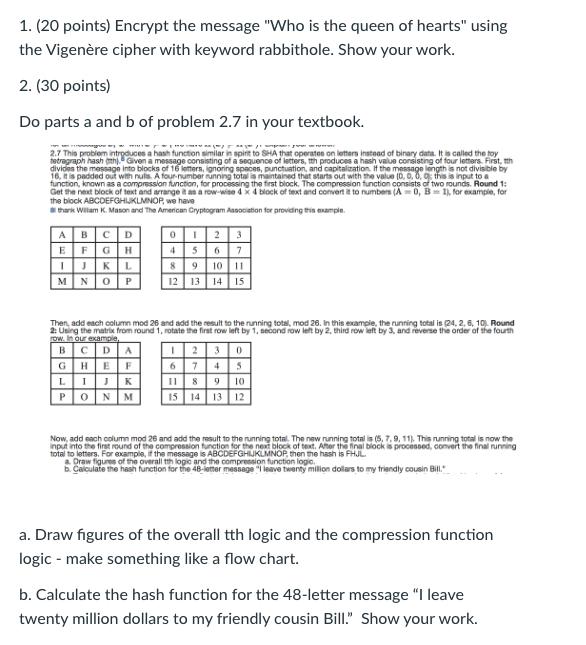
1. (20 points) Encrypt the message "Who is the queen of hearts" using the Vigenère cipher with keyword rabbithole. Show your work. 2. (30 points) Do parts a and b of problem 2.7 in your textbook. 2.7 This problem introduces a hash function similar inspire to SHA that operates on letters instead of binary data. It is called the toy Istragraph hash (th). Given a message consisting of a sequence of letters, th produces a hash value consisting of four letters. First, th divides the message into blocks of 16 letters, ignoring Spaces, punctuation, and capitalization. If the message length is not divisible by 16. Ris padded out with us. A four number running totals maintained that starts out with the value (0.0.0.9. this is input to a function, known as a compression function, for processing the first block. The compression function consists of two rounds. Round 1: Get the next block of text and arrange it as a row-Wide 4 x 4 block of text and convert it to numbers (A=0, B = 1), for example, for the block ABCDEFGHUKLMNOP, we have Shark Willam K. Mason and The American Cryptogram Association for providing this example 0 А в с D EFGH IDKL M N O P 12 3 4 5 6 7 8 9 10 11 12 13 14 15 Then add each column mod 26 and add the result to the running total,mod 26. In this example, the running total is 24, 2, 6, 10). Round 2. Using the matrix from round 1, rotate the first row left by 1, second row left by 2. third row oft by 3, and reverse the order of the fourth row. In our example, BC DA 123 0 G HEF 6 745 LIK 11 8 9 10 PO NM 15 14 13 12 Now, add each column mod 26 and add the result to the running total. The new running totalis (5,7,9,11). This running total is now the input into the first round of the compression function for the next block of text. After the final block is processed, convert the final running total to letters. For example, if the message is ABCDEFGHIJKLMNOP, then the hash is FHJL Draw figures of the overall Ith logic and the compression function logio 6. Calculate the hash function for the 48-letter message " leave twenty milion dollars to my friendly cousin Bill a. Draw figures of the overall tth logic and the compression function logic - make something like a flow chart. b. Calculate the hash function for the 48-letter message "I leave twenty million dollars to my friendly cousin Bill.” Show your work.
3. 20 points Alice wishes to both encrypt and sign a message m for Bob. Specify the actions that Alice must carry out, and the data values to be sent to Bob. Explain your choice of whether signing or encryption should be done first. Be specific about what data values are included within the scope of the signature operation, and the encryption operation; use equations as necessary. Similarly specify the actions Bob must carry out to both decrypt the message and verify the digital signature. 4. 30 points Using p = 5 and q = 7, encrypt and decrypt a “message” (use a number less than n). Here n = 35, and o(n) = (p - 1)(q - 1) = (4)(6) = 24. Does e = 5 satisfy the rules? Does that then imply d = 5 to satisfy the required equation? Now with pencil and paper-yes, by hand! - compute the RSA encryption of m = 2 to ciphertext c, and the decryption of c back to m. The exponentiation is commonly done by repeated multiplication, reducing partial results mod n (i.e., subtract off multiples of the modulus 35 in interim steps).