Page 1 of 1
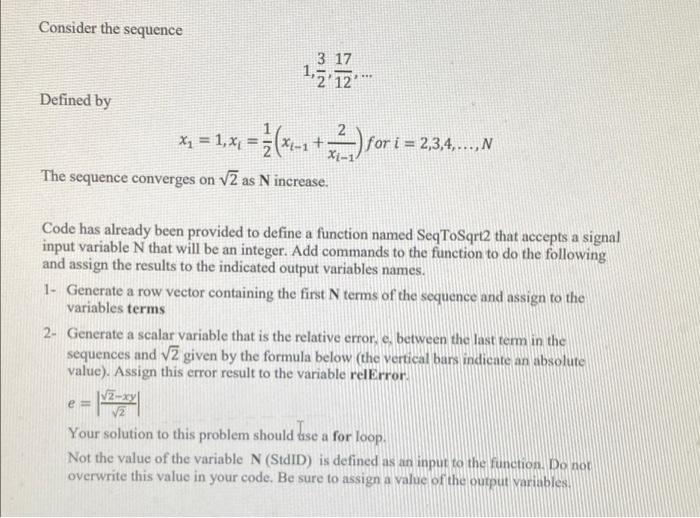
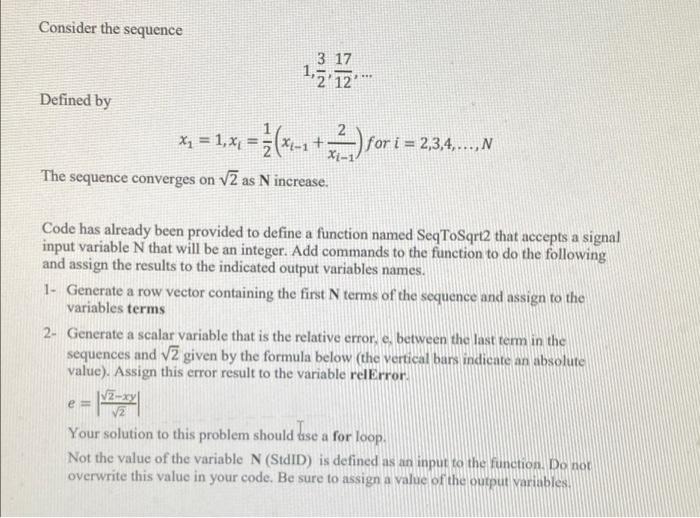
Consider the sequence 3 17 1.2 12 Defined by X; = 1,xp -- }(2-3 + 2) so ) i = X1 for i = 2,3,4,..., N Xi-1 The sequence
Posted: Fri May 20, 2022 4:48 pm
by answerhappygod
- Consider The Sequence 3 17 1 2 12 Defined By X 1 Xp 2 3 2 So I X1 For I 2 3 4 N Xi 1 The Sequence 1 (63.99 KiB) Viewed 44 times
- Consider The Sequence 3 17 1 2 12 Defined By X 1 Xp 2 3 2 So I X1 For I 2 3 4 N Xi 1 The Sequence 2 (63.99 KiB) Viewed 44 times
Consider the sequence 3 17 1.2 12 Defined by X; = 1,xp -- }(2-3 + 2) so ) i = X1 for i = 2,3,4,..., N Xi-1 The sequence converges on V2 as N increase. Code has already been provided to define a function named SeqToSqrt2 that accepts a signal input variable N that will be an integer. Add commands to the function to do the following and assign the results to the indicated output variables names. 1. Generate a row vector containing the first N terms of the sequence and assign to the variables terms 2- Generate a scalar variable that is the relative error, e between the last term in the sequences and V2 given by the formula below (the vertical bars indicate an absolute value). Assign this error result to the variable relError: 12-yl V2 Your solution to this problem should use a for loop Not the value of the variable N (StdID) is defined as an input to the function. Do not overwrite this value in your code. Be sure to assign a value of the output variables. e =