Page 1 of 1
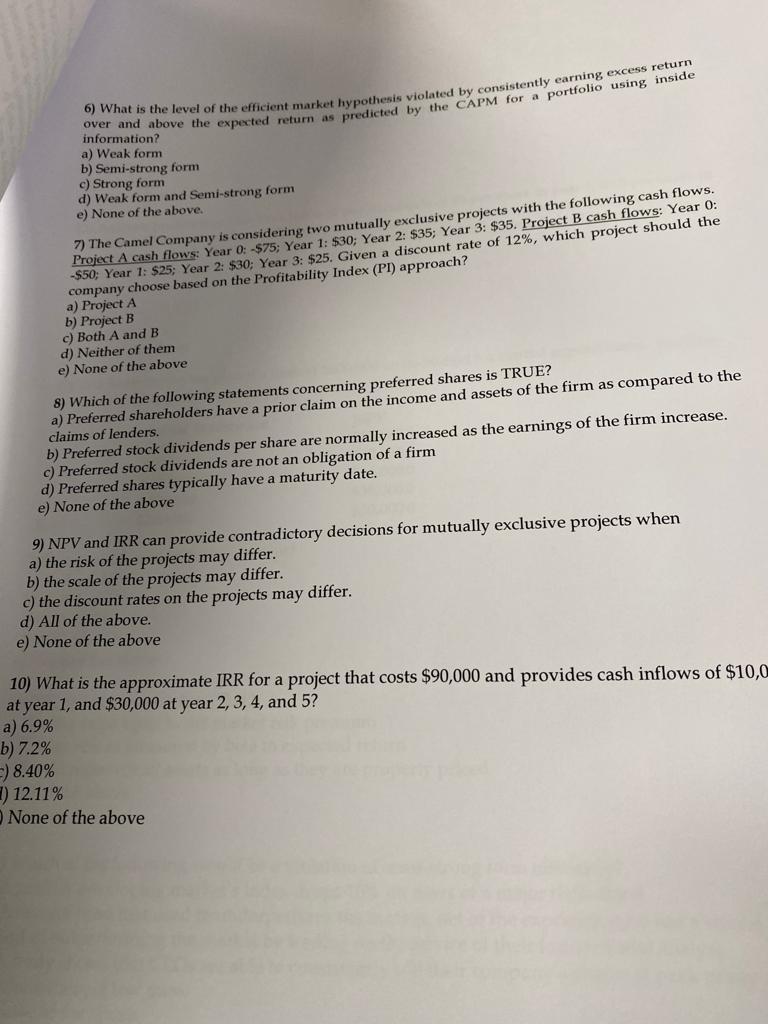
6) What is the level of the efficient market hypothesis violated by consistently earning excess return over and above th
Posted: Wed May 18, 2022 10:33 pm
by answerhappygod
- 6 What Is The Level Of The Efficient Market Hypothesis Violated By Consistently Earning Excess Return Over And Above Th 1 (82.72 KiB) Viewed 68 times
6) What is the level of the efficient market hypothesis violated by consistently earning excess return over and above the expected return as predicted by the CAPM for a portfolio using inside information? a) Weak form b) Semi-strong form c) Strong form d) Weak form and Semi-strong form e) None of the above. 7) The Camel Company is considering two mutually exclusive projects with the following cash flows. Project A cash flows: Year 0: $75; Year 1: $30; Year 2: $35; Year 3: $35. Project B cash flows: Year 0: -$50; Year 1: $25: Year 2: $30; Year 3: $25. Given a discount rate of 12%, which project should the company choose based on the Profitability Index (PI) approach? a) Project A b) Project B c) Both A and B d) Neither of them e) None of the above 8) Which of the following statements concerning preferred shares is TRUE? a) Preferred shareholders have a prior claim on the income and assets of the firm as compared to the claims of lenders. b) Preferred stock dividends per share are normally increased as the earnings of the firm increase. c) Preferred stock dividends are not an obligation of a firm d) Preferred shares typically have a maturity date. e) None of the above 9) NPV and IRR can provide contradictory decisions for mutually exclusive projects when a) the risk of the projects may differ. b) the scale of the projects may differ. c) the discount rates on the projects may differ. d) All of the above. e) None of the above 10) What is the approximate IRR for a project that costs $90,000 and provides cash inflows of $10,0 at year 1, and $30,000 at year 2, 3, 4, and 5? a) 6.9% b) 7.2% =) 8.40% 12.11% None of the above