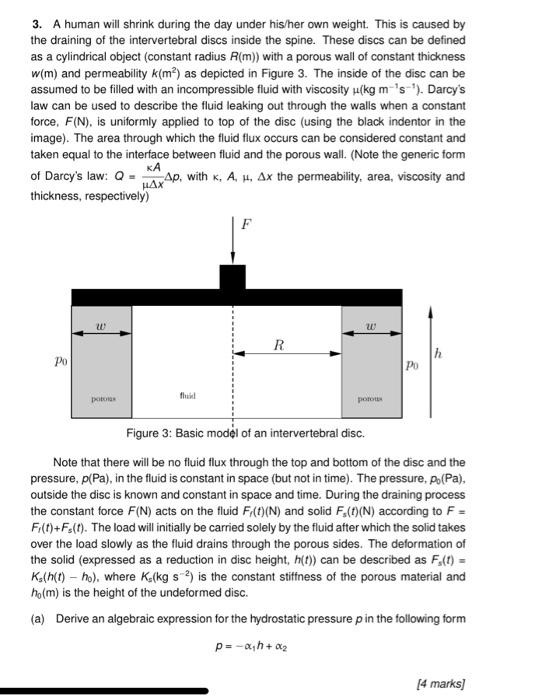
- 3 A Human Will Shrink During The Day Under His Her Own Weight This Is Caused By The Draining Of The Intervertebral Dis 1 (68.85 KiB) Viewed 55 times
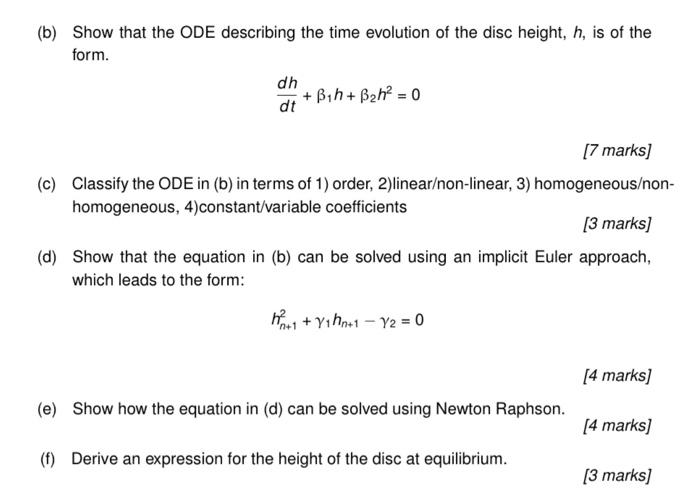
- 3 A Human Will Shrink During The Day Under His Her Own Weight This Is Caused By The Draining Of The Intervertebral Dis 2 (35.65 KiB) Viewed 55 times
3. A human will shrink during the day under his/her own weight. This is caused by the draining of the intervertebral discs inside the spine. These discs can be defined as a cylindrical object (constant radius R(m)) with a porous wall of constant thickness wim) and permeability kím?) as depicted in Figure 3. The inside of the disc can be assumed to be filled with an incompressible fluid with viscosity w/kg m-'s'). Darcy's law can be used to describe the fluid leaking out through the walls when a constant force, F(N). is uniformly applied to top of the disc (using the black indentor in the image). The area through which the fluid flux occurs can be considered constant and taken equal to the interface between fluid and the porous wall. (Note the generic form of Darcy's law: Q- x Ap, with K, A, H, Ax the permeability, area, viscosity and thickness, respectively KA F 20 w R po h Po po tha риоя Figure 3: Basic model of an intervertebral disc. Note that there will be no fluid flux through the top and bottom of the disc and the pressure, p(Pa), in the fluid is constant in space (but not in time). The pressure, po(Pa), outside the disc is known and constant in space and time. During the draining process the constant force F(N) acts on the fluid F.(!)(N) and solid F.(1)(N) according to F = Fi(t)+F.(1). The load will initially be carried solely by the fluid after which the solid takes over the load slowly as the fluid drains through the porous sides. The deformation of the solid (expressed as a reduction in disc height, h(t)) can be described as F.(1) = K(h(t)-ho), where K(kg s 2) is the constant stiffness of the porous material and ho(m) is the height of the undeformed disc. (a) Derive an algebraic expression for the hydrostatic pressure p in the following form p= -0,h+ az [4 marks
(b) Show that the ODE describing the time evolution of the disc height, h, is of the form. dh dt + Bih+Bah? = 0 [7 marks] (c) Classify the ODE in (b) in terms of 1) order, 2)linear/non-linear, 3) homogeneous/non- homogeneous, 4)constant/variable coefficients [3 marks] (d) Show that the equation in (b) can be solved using an implicit Euler approach, which leads to the form: Hun + y hn+1 - Y2 = 0 [4 marks) (e) Show how the equation in (d) can be solved using Newton Raphson. [4 marks] (1) Derive an expression for the height of the disc at equilibrium. [3 marks)