Page 1 of 1
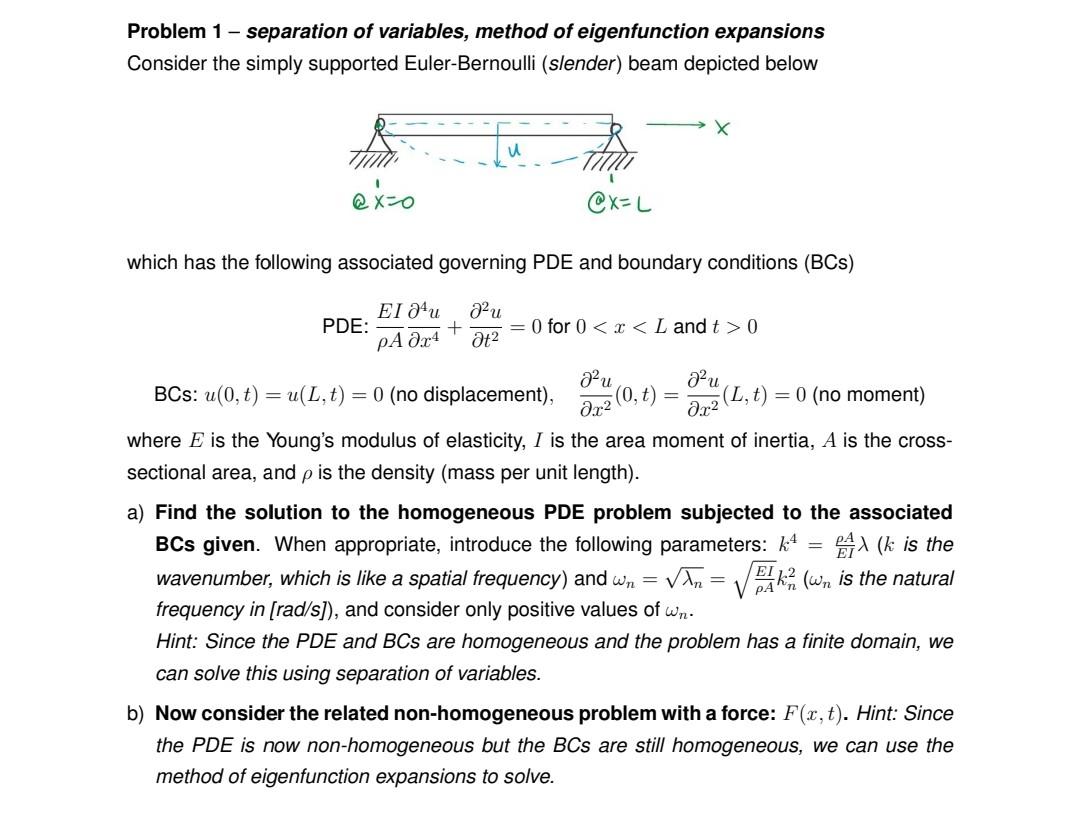
Problem 1 - separation of variables, method of eigenfunction expansions Consider the simply supported Euler-Bernoulli (s
Posted: Wed May 18, 2022 4:53 pm
by answerhappygod
- Problem 1 Separation Of Variables Method Of Eigenfunction Expansions Consider The Simply Supported Euler Bernoulli S 1 (108.04 KiB) Viewed 34 times
Problem 1 - separation of variables, method of eigenfunction expansions Consider the simply supported Euler-Bernoulli (slender) beam depicted below X u axo CX-L which has the following associated governing PDE and boundary conditions (BCs) EI 24u au PDE: + = 0 for 0 < x < L and to at2 pA дү4 მ2 au BCs: u(0,t) = u(L,t) = 0 (no displacement), au (0,t) (L,t) = 0 (no moment) a.x2 where E is the Young's modulus of elasticity, I is the area moment of inertia, A is the cross- sectional area, and p is the density (mass per unit length). ΕΙ a) Find the solution to the homogeneous PDE problem subjected to the associated BCs given. When appropriate, introduce the following parameters: k4 = A1 (k is the wavenumber, which is like a spatial frequency) and wn = An = PART (wn is the natural frequency in (rad/s]), and consider only positive values of Wn. Hint: Since the PDE and BCs are homogeneous and the problem has a finite domain, we can solve this using separation of variables. b) Now consider the related non-homogeneous problem with a force: F(x, t). Hint: Since the PDE is now non-homogeneous but the BCs are still homogeneous, we can use the method of eigenfunction expansions to solve.