Page 1 of 1
Question 12 (25 marks) A microquasar (X-ray binary) at a distance from Earth of 17 kpc, and an AGN, at a distance of 46
Posted: Wed May 18, 2022 4:38 pm
by answerhappygod
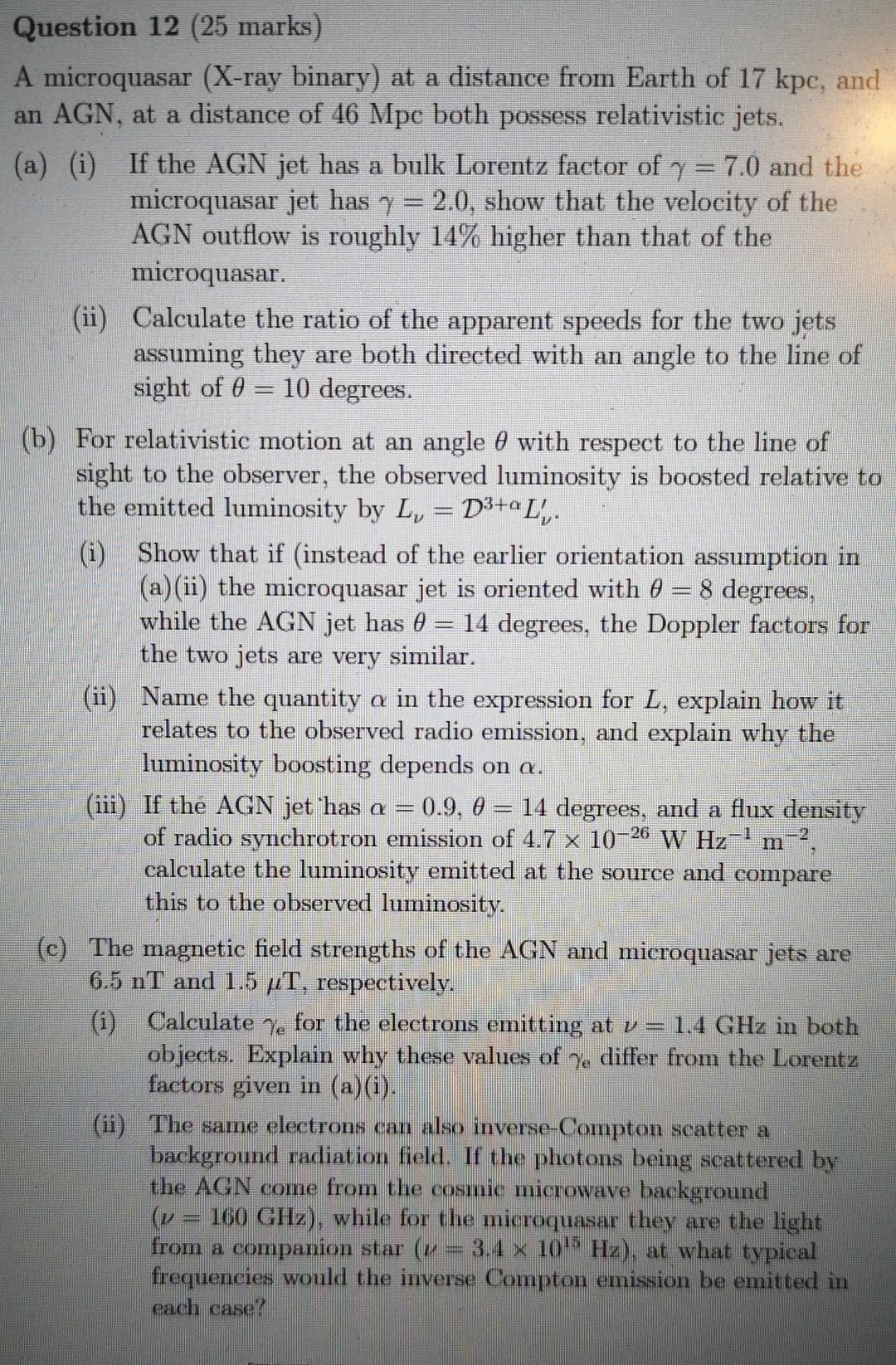
- Question 12 25 Marks A Microquasar X Ray Binary At A Distance From Earth Of 17 Kpc And An Agn At A Distance Of 46 1 (427.15 KiB) Viewed 32 times
Question 12 (25 marks) A microquasar (X-ray binary) at a distance from Earth of 17 kpc, and an AGN, at a distance of 46 Mpe both possess relativistic jets. (a) (i) If the AGN jet has a bulk Lorentz factor of n = 7.0 and the microquasar jet has y = 2.0, show that the velocity of the AGN outflow is roughly 14% higher than that of the microquasar. (ii) Calculate the ratio of the apparent speeds for the two jets assuming they are both directed with an angle to the line of sight of 6 = 10 degrees. (b) For relativistic motion at an angle 8 with respect to the line of sight to the observer, the observed luminosity is boosted relative to the emitted luminosity by L, = D3+aL,. (1) Show that if (instead of the earlier orientation assumption in (a)(ii) the microquasar jet is oriented with 6 8 degrees, while the AGN jet has 0 = 14 degrees, the Doppler factors for the two jets are very similar. (ii) Name the quantity a in the expression for L, explain how it relates to the observed radio emission, and explain why the luminosity boosting depends on a. (iii) If the AGN jet has a = 0.9, 0 = 14 degrees, and a flux density of radio synchrotron emission of 4.7 x 10⁻²⁶ W Hz-1 m-2, calculate the luminosity emitted at the source and compare this to the observed luminosity. (c) The magnetic field strengths of the AGN and microquasar jets are 6.5 nT and 1.5 ĮT, respectively. (i) Calculate y for the electrons emitting at v= 1.4 GHz in both objects. Explain why these values of "e differ from the Lorentz factors given in (a) (i). (ii) The same electrons can also inverse-Compton scatter a background radiation field. If the photons being scattered by the AGN come from the cosmic microwave background (v = 160 GHz), while for the microquasar they are the light from a companion star (v = 3.4 x 10¹⁵ Hz), at what typical frequencies would the inverse Compton emission be emitted in each case? m